

 Posted by
 What is an Open Redirect?
An Open Redirect is a web security flaw where an application blindly redirects users to a URL specified via user input, without proper validation or sanitization.
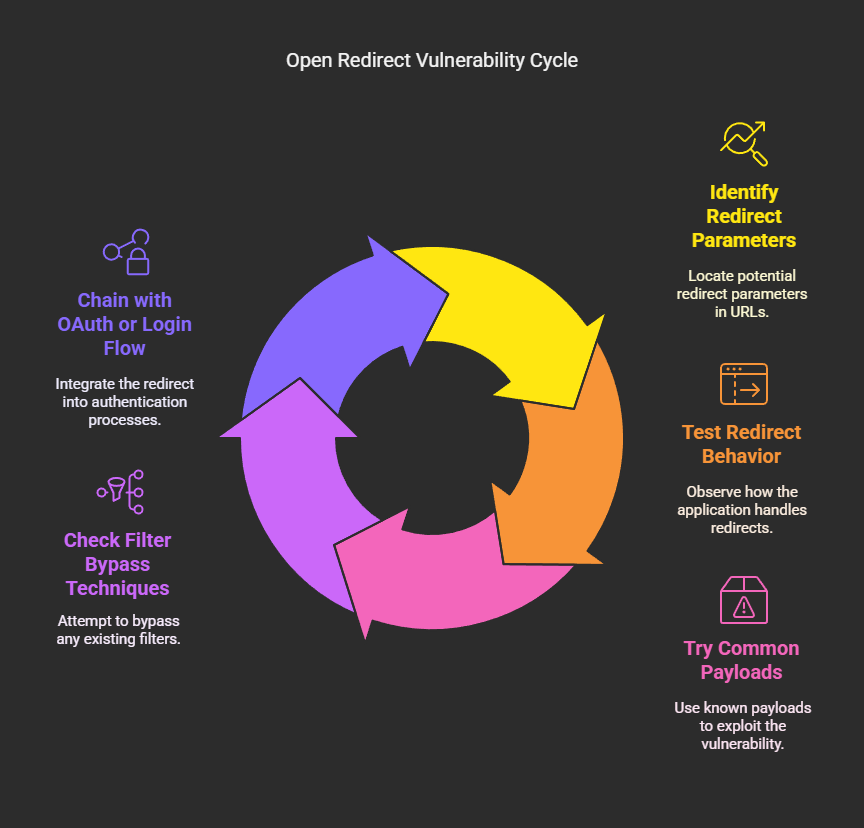
Impact: Open Redirects are often considered low-risk, but they can be chained with phishing, XSS, or authentication bypass attacks to become critical vulnerabilities.
🔥 Real-World Exploits
- 🚨 Phishing: Redirect a victim to a malicious site after clicking a trusted domain.
- 🚪 Authentication Bypass: Bypass login or OAuth flow using crafted redirect URIs.
- 🎭 Session Fixation: Lure users into authenticated sessions via a fixed redirect.
- 📥 Payload Delivery: Chain with XSS, malware, or OAuth misconfig.
🎯 Where to Look (Common Vulnerable Parameters)
Parameter NameExample
?next=https://target.com/login?next=https://evil.com
?redirect=https://target.com/redirect?redirect=https://evil.com
?url=https://target.com?url=https://evil.com
?continue=https://target.com?continue=https://evil.com
?returnUrl=https://target.com?returnUrl=https://evil.com
?dest=, ?goto=, ?forward=All are suspect!
🧭 Step-by-Step Guide to Finding Open Redirect Vulnerabilities
🔍 Step 1: Identify Redirect Parameters
Start with passive reconnaissance:
- Google Dorking:
inurl:?redirect= site:target.com inurl:?next= site:target.com - Use tools like ParamSpider, gau, or waybackurls to extract URLs.
gau target.com | grep -Ei 'redirect|url|next|return' > urls.txt
🔬 Step 2: Test Redirect Behavior
Check if the URL redirects you after clicking. Tools:
- Burp Suite (intercept and modify redirect params)
- curl or httpx to follow redirects
curl -I "https://target.com/redirect?url=https://evil.com"
Does it return Location: https://evil.com? That’s your first flag.
🧪 Step 3: Try Common Payloads
Test known payloads that bypass weak filters.
🔥 Top Payloads for Open Redirect
DescriptionPayload
Basic Redirecthttps://evil.com
Protocol-less//evil.com
Mixedhttp:evil.com
Encoded%2f%2fevil.com
Double Slash/\evil.com
Directory Jump..%2f..%2fhttps://evil.com
CRLF Injectionhttps://target.com%0d%0aLocation:https://evil.com
JavaScript Protocol (rarely allowed)javascript:alert(1)
🧠 Bonus: Use your own redirect tester link:
https://yourdomain.com/redirect-test.php
🧬 Step 4: Check Filter Bypass Techniques
If you see that some payloads are blocked, test for:
- Case-insensitive matches:
HTTPS://evil.com - Subdomain confusion:
https://evil.com.target.com - Path confusion:
/redirect?next=/\evil.com - Encoded values:
%68%74%74%70%73%3A%2F%2Fevil.com
🔄 Step 5: Chain with OAuth or Login Flow
Check login and OAuth endpoints for redirect URLs:
/oauth/authorize?redirect_uri=.../login?next=https://evil.com- After reset password or register
If the app automatically redirects you to your provided URL after authentication, it’s gold.
🔐 Many companies (Google, Facebook, GitHub) restrict redirect URIs to pre-approved domains — many small sites don’t.
🛠️ Tools You Can Use
ToolDescription
Burp SuiteIntercept, fuzz, and test redirect endpoints
ParamSpiderDiscover parameters from JS and HTML
httpxQuickly test redirect headers
OpenRedireXAutomated Open Redirect scanner
KiterunnerPath and parameter brute-forcer
qsreplaceReplace query values with payloads
FFuFFuzz URLs and parameters
OWASP ZAPPassive scanner for open redirect patterns
⚙️ Sample Automation with OpenRedireX
git clone https://github.com/devanshbatham/OpenRedireX
cd OpenRedireX
cat urls.txt | python3 openredirex.py -p payloads.txt -o results.txt
✅ Validating the Vulnerability
- Confirm redirection without user interaction
- Redirect occurs server-side, not just JS
- Your destination URL is reflected in the Location header
- Try it in a browser — does it go to
evil.com?
📋 Reporting Template for Bug Bounties
**Summary:** Open Redirect in `redirect` parameter allows redirection to arbitrary domains.

**Steps to Reproduce:**
1. Visit: `https://target.com/redirect?url=https://evil.com`
2. Observe redirection to `https://evil.com`

**Impact:**
- Can be used in phishing attacks
- Can bypass login/OAuth protection
- Could be chained with XSS or session stealing

**Recommendation:**
- Validate redirect URLs against a whitelist
- Use relative paths (e.g., `/dashboard`) instead of full URLs
- Reject URLs pointing to external domains
🛡️ How to Prevent Open Redirects
Bad PracticeGood Practice
Redirecting user input blindlyUse a whitelist of safe URLs
Allowing full URLsAccept only relative paths
Trusting query param URLsValidate the domain strictly
Returning 302 with user-provided inputRedirect to static route or home page if invalid
Example safe server logic (Python/Flask):
allowed = ['/dashboard', '/settings']
url = request.args.get('next')
if url not in allowed:
    return redirect('/')
return redirect(url)
🏁 Final Thoughts
Open Redirects may seem low impact, but when used creatively, they can lead to phishing, account takeover, OAuth abuse, and serious security flaws. With a solid strategy and payloads, they’re one of the easiest web bugs to find — and many companies still reward them!
 Spyboy blog