

 Posted by
 The internet has become the primary source of information for billions of users worldwide, with search engines like Google, Bing, and Yahoo acting as gateways to content. However, cybercriminals have found ways to exploit search engines through a technique called SEO Poisoning (Search Engine Optimization Poisoning). This method manipulates search rankings to make malicious websites appear as top search results, luring unsuspecting users into traps designed to distribute malware, steal credentials, or execute phishing attacks.
In this blog post, we will explore SEO Poisoning in detail—how it works, real-world examples, its impact on businesses and individuals, and how users and organizations can protect themselves against it.
1. What is SEO Poisoning?
SEO Poisoning is a cyberattack technique where malicious actors manipulate search engine algorithms to boost the ranking of harmful websites. By exploiting legitimate SEO techniques, attackers can make their sites appear at the top of search results, increasing the chances of users clicking on them.
These poisoned search results often lead to:
- Malicious downloads (e.g., fake software updates, trojans, ransomware)
- Phishing sites impersonating legitimate businesses
- Credential harvesting pages designed to steal login information
- Cryptojacking scripts that secretly mine cryptocurrency using the victim’s device
Attackers primarily target trending topics, popular software downloads, breaking news, and high-demand services to maximize their reach.
2. How SEO Poisoning Works
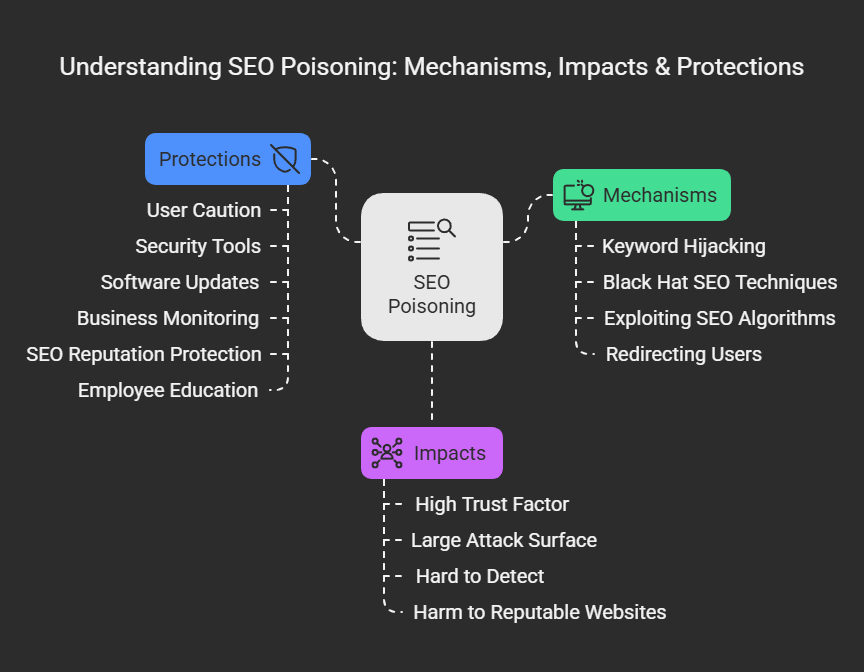
2.1 Keyword Hijacking
Cybercriminals research trending and high-traffic keywords to identify search terms that users are likely to look for. They then create malicious web pages optimized with these keywords to rank higher in search engine results.
2.2 Black Hat SEO Techniques
Hackers use unethical SEO strategies to trick search engines into ranking their malicious pages. These techniques include:
- Keyword Stuffing: Overloading a page with popular keywords to manipulate rankings.
- Cloaking: Showing different content to search engine crawlers and real users.
- Link Farms: Creating networks of linked sites to artificially boost search rankings.
- Compromising Legitimate Websites: Injecting malicious content into hacked websites that already have strong domain authority.
2.3 Exploiting SEO Algorithms
Attackers take advantage of search engine ranking factors such as backlinks, content relevance, and domain authority to get their sites indexed and ranked quickly.
2.4 Redirecting Users
Once a user clicks on a poisoned search result, they are often redirected multiple times to different domains before landing on the final malicious page. This helps attackers avoid detection by search engines.
3. Real-World Examples of SEO Poisoning Attacks
3.1 SolarMarker Malware (2021)
In 2021, researchers identified a campaign where attackers used SEO poisoning to distribute the SolarMarker malware. The attack involved creating fake PDF pages optimized for search engines. Users searching for specific document-related keywords would land on these sites, where they were tricked into downloading malware-infected files.
3.2 Log4j Exploit (2022)
After the Log4j vulnerability was discovered in 2021, cybercriminals quickly poisoned search results with fake Log4j patch downloads. Victims who searched for “Log4j fix” or “Log4j patch” were directed to malicious sites that installed malware instead of the legitimate patch.
3.3 COVID-19 Scam Websites (2020)
During the COVID-19 pandemic, attackers leveraged SEO Poisoning to spread misinformation and distribute malware. Fake websites offering pandemic relief funds, vaccine appointments, and health updates ranked high in search results, leading users to phishing sites.
4. Why SEO Poisoning is Dangerous
4.1 High Trust Factor
Users often trust search engines, assuming that top-ranked results are legitimate. Cybercriminals exploit this trust to spread malware and phishing scams.
4.2 Large Attack Surface
Since search engines are used by billions of people daily, SEO Poisoning enables attackers to target a massive audience with minimal effort.
4.3 Hard to Detect
SEO Poisoning campaigns often blend with legitimate search results, making it difficult for users to identify malicious links. Even security tools may struggle to detect poisoned search results in real-time.
4.4 Can Harm Reputable Websites
Hackers frequently hijack legitimate sites with strong domain authority to push malicious content. Businesses with compromised websites may unknowingly contribute to SEO Poisoning, damaging their reputation.
5. How to Protect Against SEO Poisoning
5.1 For Individual Users
Be Cautious of Search Results
- Avoid clicking on unfamiliar or suspicious search results, even if they appear at the top.
- Double-check URLs before entering sensitive information.
- Prefer official websites for software downloads instead of third-party sites.
Use Security Tools
- Install a reputable antivirus and anti-malware program.
- Enable browser security features that warn against malicious sites.
- Use ad-blockers and script blockers to prevent unwanted redirects.
Keep Software Updated
- Ensure that your browser, OS, and security software are always up to date to minimize the risk of exploitation.
5.2 For Businesses and Website Owners
Monitor Website Security
- Regularly scan your website for vulnerabilities and malware infections.
- Use Content Security Policy (CSP) to prevent unauthorized script execution.
Protect SEO Reputation
- Monitor backlinks to your website and disavow suspicious links that could be used for SEO Poisoning.
- Regularly audit website content for unauthorized modifications.
Educate Employees and Customers
- Train employees to recognize SEO Poisoning threats and avoid suspicious search results.
- Educate customers about safe browsing habits and direct them to official sources for downloads.
6. Future Trends in SEO Poisoning
As search engine algorithms evolve, so do the tactics of cybercriminals. Future trends in SEO Poisoning may include:
- AI-Powered SEO Attacks: Attackers leveraging artificial intelligence to automate and refine SEO manipulation techniques.
- Deepfake and Misinformation Campaigns: The rise of deepfake technology may lead to more convincing phishing sites that manipulate search engine rankings.
- Exploiting Voice Search and AI Assistants: As more users rely on voice search (e.g., Google Assistant, Alexa), attackers may target these platforms to deliver poisoned results.
Conclusion
SEO Poisoning is a growing cyber threat that exploits search engines to distribute malware, steal sensitive data, and execute phishing scams. With cybercriminals continuously refining their tactics, both individuals and organizations must remain vigilant.
By adopting safe browsing habits, using security tools, and implementing strong website protection measures, we can mitigate the risks associated with SEO Poisoning. Search engines also have a role to play in improving detection mechanisms to minimize the impact of these attacks.
In the ever-evolving landscape of cybersecurity, awareness and proactive defense are the best weapons against SEO Poisoning. Stay informed, stay cautious, and always verify before you click!
Discover more from Spyboy blog
Subscribe to get the latest posts sent to your email.
