
 Posted by
 For years, your SIM card has been the weakest link in your digital security.
Most people don’t realize this.
They protect:
- Passwords
- Apps
- Devices
But ignore the one thing tied to everything:
Your phone number.
And that number is often controlled by a tiny removable plastic chip.
That’s where the problem begins.
📱 What Is eSIM (In Simple Terms)?
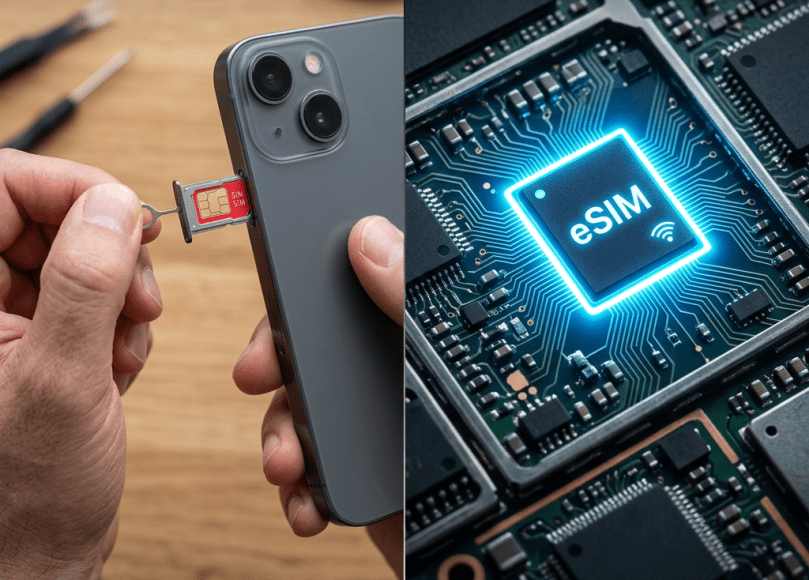
An eSIM (Embedded SIM) is a digital SIM built directly into your phone.
Instead of inserting a physical SIM card, you:
- Scan a QR code
- Activate a profile
- And your number is linked digitally
No physical chip. No tray. No swapping.
🚨 The Biggest Problem With Physical SIM Cards
Let’s talk about something most people ignore:
🔓 Physical SIM = Easy to Remove = Easy to Abuse
If someone gets your phone, they can:
- Remove your SIM in seconds
- Insert it into another device
- Start receiving:
- OTP codes
- Password resets
- Bank alerts
No password needed. No hacking required.
Just… remove and reuse.
⚠️ Real Threat: SIM-Based Attacks
📶 SIM Swap & SIM Theft
There are two major risks:
1. Physical SIM Theft
- Phone stolen → SIM removed
- Attacker inserts into another phone
- Gains access to OTPs instantly
2. SIM Swap Attack
- Hacker convinces telecom provider
- Transfers your number to their SIM
- You lose signal → they gain control
🔐 Why This Is Dangerous
Your phone number is linked to:
- Gmail
- Banking apps
- UPI
- OTP verification
So once someone controls your SIM:
They can reset almost everything.
🛡️ How eSIM Changes the Game
🔒 1. No Physical SIM to Remove
With eSIM:
- There is nothing to take out
- No tray
- No chip
Even if your phone is stolen:
- Your number stays locked inside the device
📵 2. Harder for Attackers to Transfer
Unlike physical SIM:
- eSIM transfer requires authentication
- Often requires QR code / carrier approval
- Cannot be instantly moved to another phone
🔐 3. Stronger Protection Against SIM Theft
With eSIM:
- Thief cannot just insert SIM into another phone
- They lose easy access to OTP-based accounts
🧠 4. Adds a Layer of Security (Very Important)
Think of it like:
| Method | Effort for Attacker |
|---|---|
| Physical SIM | Very Easy |
| eSIM | Requires carrier-level access |
👉 This difference is huge.
🔥 Real Scenario Comparison
📱 Physical SIM Case:
- Phone stolen
- SIM removed
- Inserted into attacker’s phone
- OTPs received
- Accounts reset
Time taken: 2–5 minutes
📱 eSIM Case:
- Phone stolen
- No SIM to remove
- Attacker cannot access OTP
- Needs telecom-level attack
Time taken: Much harder / often fails
🧠 Why Hackers Prefer Physical SIM Targets
Because:
- It’s fast
- No technical skill required
- Works instantly
eSIM removes this simplicity.
📊 Additional Benefits of eSIM
🌍 1. Multiple Profiles on One Device
- Use multiple numbers
- Switch without swapping SIM
✈️ 2. Perfect for Travel
- Activate international plans instantly
- No need to buy local SIM cards
⚡ 3. Faster Setup
- No physical handling
- Instant activation
🔄 4. Less Wear & Tear
- No SIM tray damage
- No loose contacts
🔐 5. Better Integration with Device Security
- Linked to device hardware
- Works with system-level protections
⚠️ Drawbacks of eSIM (Let’s Be Honest)
No technology is perfect.
❌ 1. Harder to Transfer Between Phones
- You can’t just swap SIM
- Requires carrier process
❌ 2. Limited Support (Still Improving)
- Not all devices support eSIM
- Some carriers still lag
❌ 3. Troubleshooting Can Be Annoying
- If something breaks → no quick SIM swap
- May require customer support
❌ 4. Still Not Immune to SIM Swap Attacks
- Telecom-level attacks can still happen
- But physical theft risk is reduced
🧠 Important Truth
eSIM doesn’t make you unhackable.
It removes one of the easiest attack paths.
And that matters a lot.
🛡️ Best Practices (Even with eSIM)
✅ Use Authenticator Apps
- Avoid SMS-based OTP when possible
✅ Secure Your Carrier Account
- Add PIN/password
- Prevent unauthorized SIM transfers
✅ Enable Device Lock
- Strong PIN or biometric
✅ Monitor Signal Loss
- Sudden “No Service” = possible SIM attack
📊 Quick Comparison Table
| Feature | Physical SIM | eSIM |
|---|---|---|
| Removable | ✅ Yes | ❌ No |
| Theft Risk | 🔥 High | ⚠️ Low |
| Instant Transfer | ✅ Easy | ❌ Restricted |
| Security Level | Basic | Stronger |
| Convenience | Medium | High |
🔍 Who Should Definitely Use eSIM?
- Content creators / influencers
- Business owners
- Anyone using banking apps
- People concerned about privacy
- Frequent travelers
👉 Basically… everyone with something to lose
🔚 Final Thoughts
Your phone number is:
- A login key
- A recovery method
- A security layer
And with a physical SIM…
That key can be removed in seconds.
Switching to eSIM won’t solve everything—
but it removes one of the most overlooked vulnerabilities.
📣 Final Call to Action
If your device supports eSIM:
- Consider switching
- Secure your telecom account
- Move away from SMS-based security
Because in cybersecurity:
The easiest attack is the one hackers choose first.
Don’t give them that option.
❓ FAQ
Is eSIM safer than physical SIM?
Yes, especially against physical SIM theft. It removes the ability to quickly move your number to another device.
Can hackers still perform SIM swap on eSIM?
Yes, but it’s harder and requires telecom-level access.
What happens if my eSIM phone is stolen?
Your number remains tied to the device, making it harder for attackers to access OTPs.
Can I switch back to physical SIM?
Yes, depending on your carrier.
Does eSIM affect network quality?
No, performance is the same as physical SIM.
Discover more from Spyboy blog
Subscribe to get the latest posts sent to your email.
