

 Posted by
 When people hear the word hacking, they imagine shattered firewalls, cracked passwords, and zero-day exploits.
That picture is comforting — because it suggests attacks are loud, technical, and detectable.
The reality in 2025 is far more disturbing:
Most major platforms don’t get “broken into.”
They get walked into.
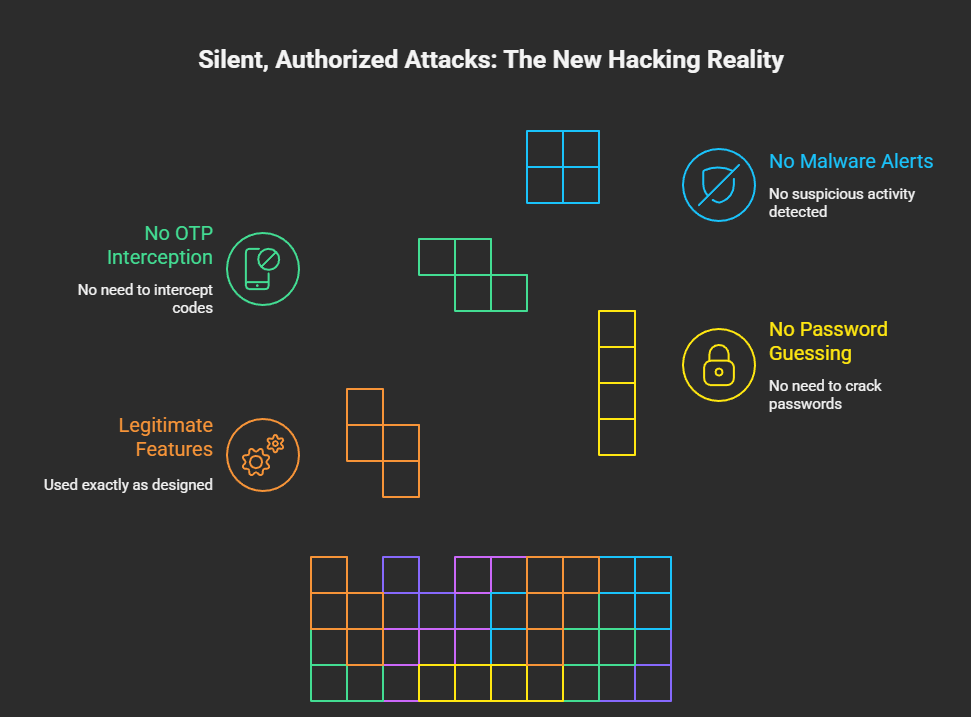
No password guessing.
No OTP interception.
No malware alerts.
Just legitimate features, used exactly as designed — against you.
🧠 The Security Illusion We All Believe In
We’ve been taught a simple model:
- Strong password = safe
- OTP / 2FA = safer
- No alerts = no breach
This model is obsolete.
Modern attackers don’t fight authentication.
They sidestep it entirely.
🔓 Authentication Is Strong — Authorization Is the Weak Point
Every major platform today — including WhatsApp, Instagram, and Google — has excellent authentication.
But attacks don’t target authentication anymore.
They target authorization.
The difference:
- Authentication → Who are you?
- Authorization → What are you allowed to do?
Once something is authorized:
- OTPs are bypassed
- Alerts don’t fire
- Logs look clean
From the platform’s view:
“The user approved this.”
🎯 Why “Breaking In” Is No Longer Necessary
Breaking in is:
- Hard
- Noisy
- Risky
Walking in is:
- Easy
- Silent
- Scalable
Attackers realized something critical:
If users can approve actions, attackers can trick them into approving attacks.
🧩 The Universal Attack Pattern (Works Everywhere)
Whether it’s email, social media, cloud, or messaging apps, the pattern is the same:
- Create trust
- Create urgency
- Trigger a legitimate feature
- Let the user authorize access
No exploit required.
🎭 How This Looks Across Major Platforms
📱 Messaging Apps
- Abuse Linked Devices
- Victim links attacker’s device
- Messages are mirrored silently
No login. No alert.
📸 Social Media Platforms
- Abuse OAuth (“Login with…”)
- Abuse Business / Admin roles
- Abuse account recovery flows
Victim never shares a password.
📧 Email Platforms
- Abuse third-party app permissions
- Abuse active sessions
- Abuse recovery options
Attacker reads mail while security says everything is fine.
☁️ Cloud & SaaS Tools
- Abuse shared documents
- Abuse delegated access
- Abuse API tokens
Entire organizations get compromised without a single password leak.
🚫 Why Security Systems Don’t Stop This
Because nothing illegal happened technically.
- The user clicked “Allow”
- The user linked the device
- The user approved access
Security tools are designed to stop:
- Brute force
- Malware
- Unauthorized access
They are not designed to stop consent.
👁️ Why Victims Say “I Was Never Hacked”
Most victims report:
- No OTP
- No warning
- No suspicious login
That’s because:
The system never detected an intrusion.
The attacker never broke policy.
The user followed instructions.
🧠 The Real Vulnerability Isn’t Code — It’s Context
Attackers exploit:
- Authority (“Security Team”)
- Familiarity (“Your friend shared this”)
- Fear (“Account will be disabled”)
- Urgency (“24 hours remaining”)
Humans respond faster than they think.
Security assumes users think slowly.
That mismatch is the gap attackers live in.
🛡️ Why “More Security” Doesn’t Automatically Help
Adding:
- More OTPs
- Stronger passwords
- Better encryption
Does nothing if the user is convinced to approve the attack.
You can’t OTP your way out of:
“Please confirm this action.”
🧠 The New Definition of a “Hack”
A modern hack looks like this:
- No exploit code
- No vulnerability ID
- No crash
- No alert
Just:
“Everything looks normal.”
That’s why these attacks are:
- Hard to detect
- Hard to explain
- Hard to recover from
🛡️ How Users Can Actually Defend Themselves
✅ 1. Treat Permissions Like Passwords
If something asks for access:
- Stop
- Read carefully
- Ask why
Authorization is power.
✅ 2. Audit Regularly (Almost Nobody Does)
Check:
- Linked devices
- Connected apps
- Active sessions
- Recovery emails
Attackers rely on neglect.
✅ 3. Assume Urgency = Attack
Real platforms don’t rush users.
Attackers always do.
✅ 4. Remember This Rule
If you didn’t initiate it, don’t approve it.
Simple. Powerful. Rarely followed.
🧠 For Developers & Security Teams: The Hard Truth
You can’t patch this with:
- More crypto
- Better hashing
- Stronger auth
Because the system is behaving correctly.
The failure is human-feature interaction.
The future of security isn’t just code —
it’s design, education, and friction.
🔮 The Future: Silent, Clean, Authorized Attacks
The next decade of cyber attacks will:
- Leave no forensic traces
- Use official workflows
- Blend into normal behavior
The attacker won’t “hack” your account.
They’ll get you to operate it for them.
⚠️ Final Reality Check
Every major platform can be “hacked” without breaking in
because breaking in is optional.
All it takes is:
- A feature
- A message
- A moment of trust
And that’s the most dangerous truth in cybersecurity today.
🧨 The door was never locked —
it was politely opened.
📢 Share this post. Someone you know believes passwords are enough.
Stay skeptical. Stay informed. Stay safe.
Discover more from Spyboy blog
Subscribe to get the latest posts sent to your email.
