

 Posted by
 When people hear the word hacking, they imagine shattered firewalls, cracked passwords, and zero-day exploits.
That picture is comforting — because it suggests attacks are loud, technical, and detectable.
The reality in 2025 is far more disturbing:
Most major platforms don’t get “broken into.”
They get walked into.
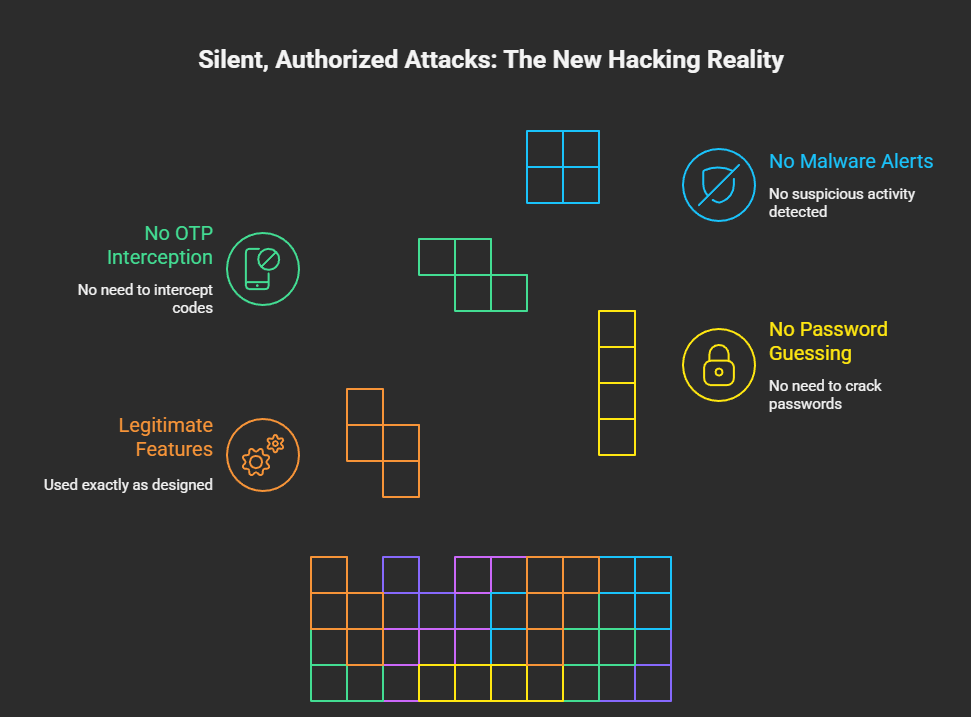
No password guessing.
No OTP interception.
No malware alerts.
Just legitimate features, used exactly as designed — against you.
🧠 The Security Illusion We All Believe In
We’ve been taught a simple model:
- Strong password = safe
- OTP / 2FA = safer
- No alerts = no breach
This model is obsolete.
Modern attackers don’t fight authentication.
They sidestep it entirely.
🔓 Authentication Is Strong — Authorization Is the Weak Point
Every major platform today — including WhatsApp, Instagram, and Google — has excellent authentication.
But attacks don’t target authentication anymore.
They target authorization.
The difference:
- Authentication → Who are you?
- Authorization → What are you allowed to do?
Once something is authorized:
- OTPs are bypassed
- Alerts don’t fire
- Logs look clean
From the platform’s view:
“The user approved this.”
🎯 Why “Breaking In” Is No Longer Necessary
Breaking in is:
- Hard
- Noisy
- Risky
Walking in is:
- Easy
- Silent
- Scalable
Attackers realized something critical:
If users can approve actions, attackers can trick them into approving attacks.
🧩 The Universal Attack Pattern (Works Everywhere)
Whether it’s email, social media, cloud, or messaging apps, the pattern is the same:
- Create trust
- Create urgency
- Trigger a legitimate feature
- Let the user authorize access
No exploit required.
🎭 How This Looks Across Major Platforms
📱 Messaging Apps
- Abuse Linked Devices
- Victim links attacker’s device
- Messages are mirrored silently
No login. No alert.
📸 Social Media Platforms
- Abuse OAuth (“Login with…”)
- Abuse Business / Admin roles
- Abuse account recovery flows
Victim never shares a password.
📧 Email Platforms
- Abuse third-party app permissions
- Abuse active sessions
- Abuse recovery options
Attacker reads mail while security says everything is fine.
☁️ Cloud & SaaS Tools
- Abuse shared documents
- Abuse delegated access
- Abuse API tokens
Entire organizations get compromised without a single password leak.
🚫 Why Security Systems Don’t Stop This
Because nothing illegal happened technically.
- The user clicked “Allow”
- The user linked the device
- The user approved access
Security tools are designed to stop:
- Brute force
- Malware
- Unauthorized access
They are not designed to stop consent.
👁️ Why Victims Say “I Was Never Hacked”
Most victims report:
- No OTP
- No warning
- No suspicious login
That’s because:
The system never detected an intrusion.
The attacker never broke policy.
The user followed instructions.
🧠 The Real Vulnerability Isn’t Code — It’s Context
Attackers exploit:
- Authority (“Security Team”)
- Familiarity (“Your friend shared this”)
- Fear (“Account will be disabled”)
- Urgency (“24 hours remaining”)
Humans respond faster than they think.
Security assumes users think slowly.
That mismatch is the gap attackers live in.
🛡️ Why “More Security” Doesn’t Automatically Help
Adding:
- More OTPs
- Stronger passwords
- Better encryption
Does nothing if the user is convinced to approve the attack.
You can’t OTP your way out of:
“Please confirm this action.”
🧠 The New Definition of a “Hack”
A modern hack looks like this:
- No exploit code
- No vulnerability ID
- No crash
- No alert
Just:
“Everything looks normal.”
That’s why these attacks are:
- Hard to detect
- Hard to explain
- Hard to recover from
🛡️ How Users Can Actually Defend Themselves
✅ 1. Treat Permissions Like Passwords
If something asks for access:
- Stop
- Read carefully
- Ask why
Authorization is power.
✅ 2. Audit Regularly (Almost Nobody Does)
Check:
- Linked devices
- Connected apps
- Active sessions
- Recovery emails
Attackers rely on neglect.
✅ 3. Assume Urgency = Attack
Real platforms don’t rush users.
Attackers always do.
✅ 4. Remember This Rule
If you didn’t initiate it, don’t approve it.
Simple. Powerful. Rarely followed.
🧠 For Developers & Security Teams: The Hard Truth
You can’t patch this with:
- More crypto
- Better hashing
- Stronger auth
Because the system is behaving correctly.
The failure is human-feature interaction.
The future of security isn’t just code —
it’s design, education, and friction.
🔮 The Future: Silent, Clean, Authorized Attacks
The next decade of cyber attacks will:
- Leave no forensic traces
- Use official workflows
- Blend into normal behavior
The attacker won’t “hack” your account.
They’ll get you to operate it for them.
⚠️ Final Reality Check
Every major platform can be “hacked” without breaking in
because breaking in is optional.
All it takes is:
- A feature
- A message
- A moment of trust
And that’s the most dangerous truth in cybersecurity today.
🧨 The door was never locked —
it was politely opened.
📢 Share this post. Someone you know believes passwords are enough.
Stay skeptical. Stay informed. Stay safe.
 Spyboy blog