
 Posted by
 The Question That Shook Parliament
Recently, a concern was raised in Parliament about India’s digital payment system — UPI. The core question was simple but powerful:
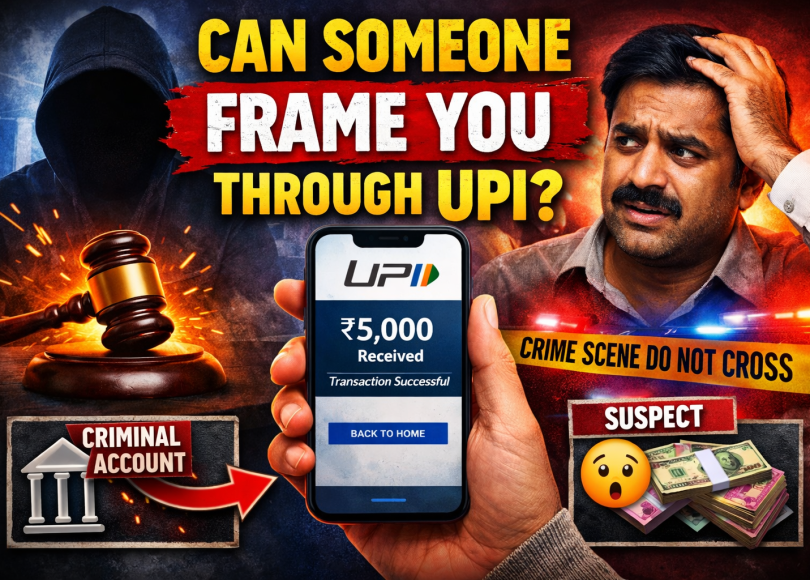
Since anyone can send money to anyone’s UPI ID, what if a criminal sends money to an innocent person — and that person becomes a suspect in a criminal investigation?
It’s a thought that makes many Indians uncomfortable.
With over billions of monthly transactions, India’s digital backbone runs on
National Payments Corporation of India (NPCI)’s Unified Payments Interface (UPI).
But when money can move instantly, 24/7, with just a mobile number or QR code — does that create new risks?
Let’s break this down in a detailed, practical, and legally grounded way.

Understanding UPI: India’s Digital Revolution
UPI is not just an app — it’s a financial infrastructure.
It allows:
- Instant bank-to-bank transfers
- Payments via UPI ID, mobile number, QR code
- 24/7 real-time settlement
- Zero or minimal transaction charges
Apps built on UPI include:
- PhonePe
- Google Pay
- Paytm
- BHIM
UPI is regulated under the supervision of
Reserve Bank of India (RBI).
Today, even a roadside tea stall accepts QR payments. That’s the scale of adoption.
The Core Concern: Can You Be Framed Through UPI?
Let’s restate the fear clearly:
A criminal commits fraud.
That criminal sends stolen money to your UPI ID.
Later, police track the money trail.
Your account appears in the chain.
You become a suspect.
Scary?
Yes.
But reality is more nuanced.
How Financial Investigations Actually Work
India’s cybercrime and financial fraud investigations are not simplistic.
When authorities track illegal funds, they examine:
- Transaction patterns
- Frequency of transfers
- Whether money was withdrawn immediately
- Whether it was transferred onward
- Call data records
- Device fingerprinting
- IP addresses
- Linked accounts
- KYC details
Simply receiving money does not automatically establish criminal intent.
In Indian law, intent (mens rea) matters.
Receiving money unknowingly ≠ participating in crime.
The Difference Between an Innocent Receiver and a Money Mule
Here’s where things become important.
🟢 Innocent Receiver
- Receives random unknown transfer
- Does not withdraw or forward funds
- Reports it to bank
- No connection with sender
Low risk.
🔴 Money Mule
- Allows account to be used knowingly
- Receives frequent suspicious deposits
- Immediately transfers funds
- Shares OTP or banking access
- Gets commission for routing money
High risk. Criminal liability possible.
This is where many people get into trouble — not because money came, but because they helped move it.
Is This Risk Unique to UPI?
No.
Even before UPI:
- Anyone could deposit cash into your bank account
- Anyone could issue you a cheque
- Anyone could NEFT/RTGS transfer
UPI only made transfers:
- Faster
- Simpler
- Mobile-based
The structural risk always existed.
Could Someone Intentionally Frame You?
In theory — yes.
In practice — very difficult.
Because investigators don’t stop at “money entered your account”.
They ask:
- Did you communicate with sender?
- Did you transfer money elsewhere?
- Is this part of a larger pattern?
- Are multiple suspicious accounts linked?
- Did you benefit?
One random ₹5,000 transfer does not build a criminal case.
Real Issue: Freezing of Accounts
Now here’s the practical problem many Indians face.
Even if you’re innocent, banks sometimes:
- Freeze accounts during investigation
- Put debit freeze
- Mark account under suspicious transaction review
This can cause:
- Salary access issues
- EMI failures
- Business disruption
This is where public concern is valid.
Temporary inconvenience can happen — even without guilt.
What Should You Do If You Receive Unknown UPI Money?
If you suddenly receive suspicious funds:
- Do not withdraw it.
- Do not transfer it.
- Inform your bank immediately.
- Raise complaint inside your UPI app.
- Call 1930 (India’s cybercrime helpline).
- File complaint at cybercrime.gov.in.
Document everything.
This creates official proof of your good faith.
Regulatory Safeguards in India

Oversight involves:
- Reserve Bank of India
- National Payments Corporation of India
- Cybercrime divisions under state police
- Banking Ombudsman system
Banks must follow:
- KYC norms
- Suspicious transaction monitoring
- Anti-money laundering (AML) rules
UPI transactions are traceable — not anonymous.
Every transaction leaves a digital audit trail.
The Bigger Picture: Why UPI Still Works
Despite concerns:
- Billions of transactions happen monthly
- Fraud percentage remains small relative to volume
- Most frauds involve social engineering, not forced deposits
Common frauds include:
- OTP scams
- Fake customer care calls
- QR code request scams
- Screen sharing scams
Very rarely do cases involve framing through random deposits.
Should UPI Allow Blocking Incoming Payments?
Some argue:
Users should be able to block unknown incoming transfers.
But this creates problems:
- Merchants need open payment flow
- Salary payments may fail
- Refund systems break
India’s digital economy depends on frictionless payments.
Adding too many restrictions reduces usability.
Practical Advice for Indian Users
To stay safe:
- Do not share OTP
- Do not scan QR to receive money (QR scanning usually sends money)
- Enable transaction alerts
- Keep SMS and email notifications active
- Use strong device lock
- Avoid installing unknown apps
- Regularly check bank statements
Digital literacy is stronger protection than fear.
Legal Reality: Can You Be Arrested Just for Receiving Money?
Short answer: No.
For arrest or prosecution, authorities need:
- Evidence of knowledge
- Evidence of participation
- Evidence of benefit
- Evidence of coordination
Mere receipt without action is insufficient.
India’s criminal law requires proof beyond reasonable doubt.
So Why Did the Concern Go Viral?
Because:
- It feels plausible.
- It exploits fear of digital systems.
- It plays on lack of legal awareness.
- Account freezes create panic.
When people hear “your account is under investigation”, fear spreads fast.
But investigation ≠ conviction.
Risk Assessment: How Common Is This?
Statistically:
- Money mule cases are rising.
- Random framing cases are extremely rare.
- Most frozen accounts belong to people who unknowingly forwarded funds.
The bigger issue is lack of awareness — especially among youth renting bank accounts for quick cash.
The Future of UPI Security
We may see:
- AI-based fraud detection
- Real-time behavioral monitoring
- Faster reversal windows
- Stronger mule detection systems
- Improved grievance redressal
India’s digital payment system is still evolving.
Final Thoughts for Indian Readers
UPI is one of India’s greatest digital achievements.
Yes, theoretical risks exist.
Yes, misuse is possible.
But:
- Receiving money alone does not make you a criminal.
- Intent and action matter.
- Investigations are deeper than one transaction.
- Proper reporting protects you.
Fear should not replace understanding.
Digital literacy must grow alongside digital payments.
 Spyboy blog