

 Posted by
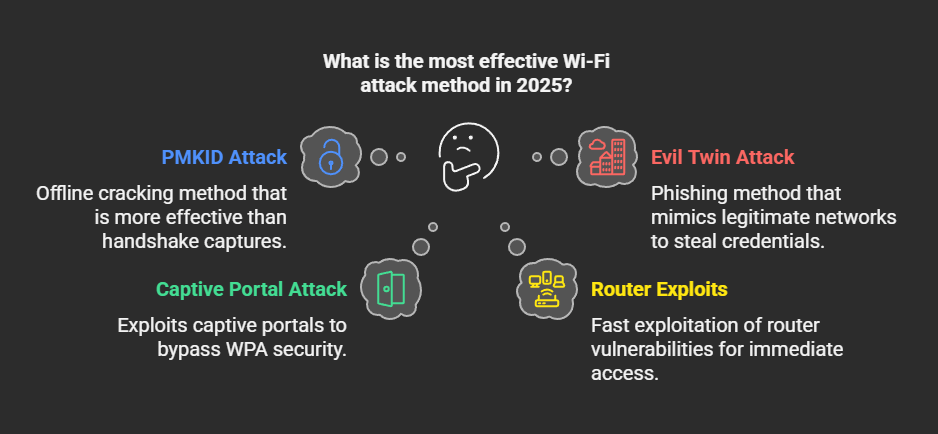
 In 2025, Wi-Fi security remains a major concern, with attackers continuously evolving their techniques to bypass modern defenses. Traditional brute-force methods are becoming less effective, while more sophisticated attacks like PMKID attacks, Evil Twin phishing, and router exploits are proving to be more successful.
This post explores the most effective Wi-Fi attacks in 2025, how they work, what tools are used, and how to defend against them.
1. PMKID Attack (Offline Cracking) – More Effective Than Handshake Captures
What is the PMKID Attack?
The PMKID (Pairwise Master Key Identifier) attack is an offline Wi-Fi password cracking method that eliminates the need to capture a full 4-way handshake. Instead, it captures a single PMKID hash, making it more efficient.
How Does It Work?
- The attacker captures a PMKID from a WPA/WPA2 router that uses 802.11i/p/r.
- The PMKID is hashed with the router’s SSID and passphrase.
- The attacker cracks the hash offline using dictionary attacks.
Tools Used
hcxdumptool(to capture PMKID)hcxpcaptool(to convert PMKID to hashcat format)hashcat(to crack the hash)
Example Command
hcxdumptool -i wlan0mon --enable_status=3 -o dump.pcapng
hcxpcaptool -z pmkid_hash.txt dump.pcapng
hashcat -m 16800 -a 0 pmkid_hash.txt rockyou.txt --force
Why is This More Effective?
✅ Works without waiting for a handshake
✅ Can be cracked offline at high speeds using GPUs
✅ Avoids the need for deauthentication attacks
Defense:
- Use a strong password (12+ characters, mix of letters/numbers/symbols)
- Enable WPA3 (which prevents PMKID attacks)
2. Evil Twin Attack – More Effective Than Brute Force
What is an Evil Twin Attack?
An Evil Twin attack involves setting up a fake Wi-Fi network that mimics a real one. Users unknowingly connect and enter credentials, which attackers steal.
How Does It Work?
- Attacker creates a fake Wi-Fi AP with the same SSID as a real network.
- Victims unknowingly connect, thinking it’s legitimate.
- A fake login page (captive portal) asks for Wi-Fi credentials.
- The attacker captures and uses the credentials.
Tools Used
airbase-ng(to create a fake AP)dnsmasq(for DHCP and DNS spoofing)Bettercap(for network manipulation and phishing portals)
Example Command
airmon-ng start wlan0
airbase-ng -a 00:11:22:33:44:55 -e "Public WiFi" wlan0mon
Why is This More Effective?
✅ Bypasses WPA encryption (No need to crack passwords)
✅ Users willingly give up their passwords
✅ Works on secured networks where brute-force fails
Defense:
- Always verify the network name before connecting.
- Use a VPN when on public Wi-Fi.
- Avoid entering passwords on captive portals.
3. Captive Portal Attack – Better Than WPA Brute-Force
What is a Captive Portal Attack?
A fake login page is used to trick users into entering Wi-Fi credentials. This is commonly used in Evil Twin attacks.
How Does It Work?
- Attacker sets up a fake Wi-Fi network.
- When a user connects, a fake login page appears.
- User enters credentials, which are stolen.
Tools Used
Wifiphisher(automates the attack)Bettercap(advanced manipulation and MITM attacks)
Example Command
wifiphisher -aI wlan0 -jI wlan1
Why is This More Effective?
✅ No need to crack WPA passwords
✅ More realistic and harder to detect
✅ Works on any device (phones, laptops, etc.)
Defense:
- Do not enter Wi-Fi passwords on pop-up login pages.
- Check the URL before entering credentials.
- Use multi-factor authentication (MFA) where possible.
4. Exploiting Router Vulnerabilities – Faster Than Brute Force
What is a Router Exploit Attack?
Instead of cracking Wi-Fi passwords, attackers exploit vulnerabilities in routers to gain control.
How Does It Work?
- Attackers scan for routers with outdated firmware.
- They exploit known vulnerabilities (CVE exploits).
- Gaining access allows them to steal credentials or modify settings.
Tools Used
RouterSploit(automated router exploitation)nmap(to find vulnerable routers)
Example Command
routersploit
use exploits/routers/linksys/
Why is This More Effective?
✅ Bypasses password cracking completely
✅ Can provide full router control
✅ Many home users fail to update firmware
Defense:
- Update router firmware regularly
- Change default credentials
- Disable remote administration
What Still Works in 2025?
| Attack | Effectiveness |
|---|---|
| WEP Cracking | ✅ Still works, but WEP is rare. |
| WPA Brute-Force | ❌ Too slow for strong passwords. |
| WPS Attacks | ❌ Most routers disable WPS. |
| Deauthentication | ⚠️ WPA3-MFP blocks this. |
| Fake AP (Evil Twin) | ✅ Still effective. |
| MAC Spoofing | ⚠️ Works but can be detected. |
Which Wi-Fi Adapter to Use for Attacks?
For penetration testing, you need a Wi-Fi adapter that supports Monitor Mode & Packet Injection. Recommended ones:
- Alfa AWUS036NHA (Best for long-range attacks)
- TP-Link TL-WN722N v1 (Cheap and reliable)
- Panda PAU09 (Works with Kali Linux, supports dual-band)
To check if your adapter supports monitor mode:
iwconfig
Final Thoughts
In 2025, brute-force attacks are ineffective due to strong passwords and security improvements. The most successful attacks involve: ✅ Offline cracking (PMKID attacks) ✅ Social engineering (Evil Twin & Captive Portals) ✅ Router exploits (outdated firmware & weak credentials)
To stay safe, always use WPA3, strong passwords, VPNs, and updated firmware. If you’re testing Wi-Fi security, use the right adapter and tools responsibly! 🚀
 Spyboy blog