

 Posted by
 “Understanding how hackers break things is the first step to building apps that resist being broken.”
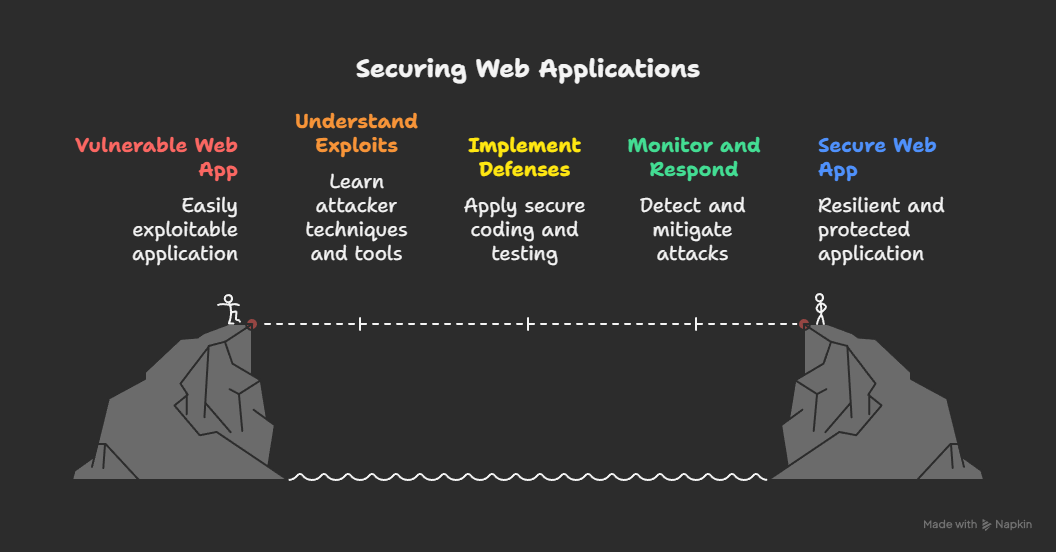
Web applications are under constant siege. In 2025, the arms race between attackers and defenders has accelerated. New techniques, AI-assisted exploit generation, and shifting architectures (APIs, microservices, serverless, mobile front ends) have changed how hackers target web apps. In this guide, we’ll peel back the layers: step by step, how attackers exploit web applications today — and more importantly, how you can defend against them.
1. Introduction — Why 2025 Is Unusually Dangerous for Web Apps
In the first half of 2025 alone, over 21,500 new CVEs have been disclosed — that’s averaging 133 new vulnerabilities per day. (DeepStrike) A staggering proportion (≈ 38%) of those are rated High or Critical. What’s more, attackers are weaponizing new bugs within hours or days of disclosure. (DeepStrike)
Simultaneously:
- 56% of respondents in a web application security survey reported a breach or compromise in the last 12 months. (Cybersecurity Insiders)
- Vulnerability exploitation is the initial access vector in 20% of confirmed breaches. (Indusface)
- Credential theft alone has spiked ~160% in 2025, now accounting for 20% of data breach root causes. (IT Pro)
These statistics underscore a brutal reality: web apps are prime targets, and defenders can’t afford to lag one step behind.
Why is 2025 different?
- Modern apps now span microservices, GraphQL, serverless, mobile backends, third-party APIs, and AI assistants — increasing the attack surface.
- AI/ML tools are lowering the barrier to exploit generation (automated fuzzing, generative payloads).
- Organizations still struggle with visibility: many can’t confidently inventory all APIs and web endpoints (only 14% were “very confident” in their inventory). (Cybersecurity Insiders)
- Supply chain attacks (malicious dependencies, compromised packages) are on the rise.
- Defenses like WAFs or per-signature systems are challenged by novel, obfuscated exploit payloads.
So: to defend 2025’s web apps, you need more than checklists — you need to think like an attacker. Let’s walk through how a modern exploit campaign proceeds.
2. The Attack Lifecycle: From Recon to Exploitation
While each hacker or team has their own style, most attacks follow a consistent flow. Here’s a canonical model that illustrates the main phases:
PhaseObjectiveTechniques / ToolsKey Risks for Defender
Reconnaissance & FootprintingDiscover entry points, tech stack, endpointsOSINT, subdomain enumeration, crawling, search engines (Google Dorks)Exposed metadata, version leaks, misconfigured endpoints
Vulnerability DiscoveryIdentify exploitable flawsAutomated scanners (Burp, ZAP, Acunetix), fuzzers, manual code review, logic auditingFalse negatives, blind spots, lack of depth
Exploitation & Payload DeliveryExecute the exploit, gain initial footholdSQL injection, SSRF, XSS, SSRF, command injection, API misuseWAF, input filtering, protections
Post-Exploitation, Persistence, Lateral MovementEscalate privileges, move sideways, exfil, maintain accessWeb shells, privilege escalation, credential dumping, pivotingLogging/monitoring, segmentation, anomaly detection
Let’s dissect each step in more detail.
2.1 Reconnaissance & Footprinting
Before injecting anything, attackers study their target. The more they know, the easier it is to plan.
Common reconnaissance steps:
- Subdomain enumeration: Use tools like
sublist3r,Amass,assetfinderto reveal subdomains (e.g.admin.example.com,api.example.com). - Certificate transparency logs: Observe domains and hosts via public certificate logs.
- Port scanning & banner grabbing: Identify open ports (80, 443, 8080), get server versions (Apache, Nginx, IIS).
- Web crawling / spidering: Map out endpoints (login, signup, search, APIs).
- Google Dorking / GitHub search: Search for leaked credentials or source files (e.g.
.env,.sql, config files). - Technology fingerprinting: Detect frameworks (Laravel, Rails, Node, Django), libraries, JS frameworks.
Tip: Even small hints — like a header
X-Powered-By: Expressor an API version/v1/— can confirm tech stacks and guide exploit choice.
2.2 Vulnerability Discovery
Once potential endpoints are mapped, attackers search for weaknesses. This stage often uses a mix of automation and manual techniques.
Common tactics:
- Static & dynamic testing: Use SAST/DAST tools to automatically flag injections, insecure endpoints.
- Fuzzing: Send malformed, random or edge-case payloads to input fields or API parameters.
- Logic / business logic review: Identify flows where the logic is inconsistent or assumptions fail (e.g. discount code abuse, skipping validations).
- Parameter tampering: Manipulate client-side parameters, hidden fields, or request bodies.
- Insecure API endpoints: Try unauthenticated access, override GET to POST, missing ACLs.
- Dependency scanning: Analyze third-party libraries for known CVEs (for example via
npm audit,Snyk).
2.3 Exploitation & Payload Delivery
Once a vulnerability is confirmed, the attacker crafts a payload and executes. The goal: transform a flaw into a concrete advantage (e.g. database read, command execution, SSRF).
Popular exploitation vectors:
- SQL / NoSQL injection: Alter queries to dump data or escalate to command execution.
- Cross-Site Scripting (XSS): Inject JS to hijack sessions or deliver payloads.
- Server-Side Request Forgery (SSRF): Force the server to call internal endpoints or services. (Wikipedia)
- Insecure deserialization / object injection: Send crafted objects to exploit code that blindly unserializes data.
- Command injection / OS injection: Pass shell commands via input parameters.
- File upload flaws / unrestricted upload: Upload web shell or malicious scripts.
- Remote Code Execution (RCE): The holy grail — execute arbitrary code on the server.
- Web shells installation: A minimal malicious script that offers remote control. (Wikipedia)
Often, multiple vulnerabilities chain together: e.g., SSRF to access internal admin API, then RCE to spin up a web shell.
2.4 Post-Exploitation, Persistence & Lateral Movement
After a foothold, the attacker’s goal is to maintain control, expand access, and exfiltrate data.
Key steps:
- Privilege escalation: Move from low-privileged user to root or admin.
- Credential dumping & reuse: Extract DB or environment secrets, reuse them.
- Lateral movement / pivoting: Use the compromised server as a staging point to attack connected systems.
- Backdoors & persistence: Keep access even if the initial vulnerability is patched.
- Exfiltration & data extraction: Move stolen data to attacker-controlled endpoints stealthily (e.g. chunked transfer).
- Log tampering / hiding traces: Remove or obfuscate logs, rootkits.
An attacker wants to remain under the radar as long as possible.
3. Top Web App Weaknesses Exploited in 2025
Below are the most frequently abused flaws in modern web apps. Many are descendants or updates of the OWASP Top 10, adapted to the complexity of modern architectures. (OWASP)
3.1 Injection (SQL, NoSQL, Command)
Injection flaws remain perennial because they are easy to exploit when input validation is weak. According to recent studies, ~23% of web apps include injection vulnerabilities. (Your pragmatic cybersecurity partner)
- SQL injection: Classic — inserting
'; DROP TABLE users;--orOR 1=1to bypass logic. - NoSQL injection: In Node.js / MongoDB apps — sending JSON or operators that alter query logic.
- Command injection: Passing
; rm -rf /or| ls -lato shell commands executed from the app.
Why it still works in 2025
- Legacy code and low-level query building.
- Incomplete input sanitization or using string concatenation.
- Blind or out-of-band (time-based) injections are harder to detect manually.
Defensive tips
- Always use prepared statements / parameterized queries.
- Use ORM frameworks that abstract queries safely.
- Whitelist allowed characters or types.
- Apply Web Application Firewalls (WAF) with contextual rules.
3.2 Broken Access Control / Authorization Flaws
Broken access control arises when the app fails to enforce who is allowed to access what. This can lead to privilege escalation, unauthorized data access, or admin functionality abuse.
Examples:
- A user changes
user_id=100touser_id=101and sees someone else’s data. - API endpoints accessible to non-admin roles.
- Missing function or endpoint-level ACLs.
In surveys, broken access control often ranks as one of the top exploited classes. (OWASP)
Mitigations:
- Enforce authorization checks server-side (never rely on client).
- Use role-based access control (RBAC) or attribute-based access control (ABAC).
- Apply defense-in-depth: revalidate permissions at every layer.
3.3 Sensitive Data Exposure / Cryptographic Failures
These flaws let attackers access or steal data due to weak encryption, misused cryptography, or data in transit/storage misconfigurations.
- Exposing passwords or keys in plaintext in code or environment.
- Using outdated encryption (MD5, SHA1) or no encryption at all.
- Weak TLS configurations, missing HSTS.
- Insecure key rotation or improper key storage (e.g. in source code).
In 2025, cryptographic failures remain a key risk area. (OWASP)
Best practices:
- Use modern, industry-accepted crypto (AES-GCM, ChaCha20, RSA-OAEP).
- Use established libraries and avoid rolling own crypto.
- Secure secrets in vaults (Vault, AWS KMS, Azure Key Vault).
- Enforce TLS 1.3+, strong cipher suites, and HSTS.
3.4 Insecure APIs & SSRF (Server-side Request Forgery)
Modern web apps heavily depend on APIs — internal and external. Improperly secured APIs are a growing attack vector.
- Unprotected internal APIs accessible from external network.
- Overly permissive CORS.
- SSRF: attacker supplies a URL to internal/private service via the web server. (Wikipedia)
- GraphQL misconfigurations (exposing resolvers, introspection).
APIs are now one of the most targeted surfaces. (Akamai)
Protection tips:
- Authenticate & authorize every API call.
- Use network isolation: internal APIs should not be reachable from the public.
- Implement input validation on URLs and disallow internal IP ranges.
- Use allow lists for API calls, server-side request filtering.
3.5 Insecure Deserialization & Object Injection
Applications that accept serialized objects (JSON, YAML, XML, Java serialized objects) can become vulnerable if they deserialize them carelessly.
- Attacker crafts malicious payloads causing code execution, logic bypass, or state manipulation.
- Chains of gadget classes may be used to trigger unintended behaviors.
Mitigations:
- Avoid accepting serialized user input.
- Use safe serialization libraries or JSON over binary formats.
- Validate object types, apply whitelist.
- Limit or disable dynamic class loading.
3.6 Security Misconfigurations
Simple, but effective. Errors in configuration often open doors.
- Debug endpoints left open (e.g.
/.env,phpinfo,/actuator). - Directory listing enabled.
- Default or weak credentials.
- Unpatched software, old versions of frameworks.
- Missing security headers (CSP, X-Frame-Options, X-XSS-Protection, etc.).
Security misconfiguration is a persistent top category in many vulnerability lists. (OWASP)
3.7 Business Logic Flaws
These are application-specific flaws that defy generic scanning.
Examples:
- Allowing customers to redeem a coupon multiple times.
- Skipping an approval step by crafting manual requests.
- Race conditions (time-of-check to time-of-use).
- Abuse of workflow states or sequence logic.
These are often subtle, require manual review and understanding of the application domain.
3.8 Logging, Monitoring & Insufficient Detection
Even if an attacker executes steps, poor logging and lack of alerts often guarantee they go undetected.
- No audit trails of crucial operations.
- Alerts only after a major threshold is crossed.
- Logs stored in same compromised server.
- Lack of differentiation between normal and suspicious traffic.
3.9 Supply-Chain / Dependency Attacks
Increasingly, attackers plant malicious code in libraries or modules that developers include. A single compromised dependency can infect many apps.
- Typosquatting (e.g.
jest-fet-mock) to trick developers into pulling malicious libs. (Wikipedia) - Malicious updates to widely used packages.
- Build pipeline compromise.
3.10 Emerging: LLM / Agent-Based Exploits
In 2025, as web apps integrate generative AI agents or browser automation agents, new vectors appear.
- GenXSS: AI-driven XSS payload generation and automated detection bypass. (arXiv)
- Agent-based compromise: Attackers embed malicious guidance in web content (e.g. in reviews or comments) that web-use agents interpret as commands to leak data or perform unauthorized actions. (arXiv)
- Multi-agent penetration (MAPTA) tools that autonomously find, craft, and verify exploits. (arXiv)
These are frontier threats, but they deserve your attention early.
4. Real-World Examples & Case Studies
It’s easy to talk hypotheticals, but concrete cases drive home the risk.
4.1 Qantas / Salesforce Data Leak (October 2025)
In October 2025, hackers claimed to have exfiltrated 5.7 million records from Qantas customers after the ransom deadline passed. The attack reportedly involved exploitation in systems tied to Salesforce. (Bright Defense)
Although details are still emerging, this incident underscores how interconnected services (SaaS, CRM integrations) expand attack surfaces.
4.2 Credential Theft Surge (2025)
Credential theft rose ~160% in 2025, according to Check Point. Leaked credentials, especially from GitHub repositories, took approximately 94 days on average to be remediated — a long window for attackers to exploit. (IT Pro)
Many breaches succeed not via exotic exploits, but by reusing leaked credentials or compromising token secrets.
4.3 Generative XSS & AI-Bypass Attacks
The GenXSS framework demonstrates how LLMs can generate sophisticated, obfuscated XSS payloads, and even automatically propose new WAF rules. In experiments, ~80% of the AI-generated payloads bypassed common WAF rulesets, and new rules blocked 86% of those bypasses. (arXiv)
This shows how attackers can rapidly outpace static defenses via AI.
4.4 Multi-Agent Exploit Discovery (MAPTA)
The MAPTA tool (Multi-Agent Penetration Testing AI) autonomously identifies and chains exploits across categories (e.g. SSRF, misconfiguration, broken authorization) with high success. In benchmarks, MAPTA achieved ~76.9% success across a variety of challenge apps. (arXiv)
This signals that even “novice” adversaries may soon have powerful exploit automation at their disposal.
4.5 Web Shell Installation & Persistent Access
Once attackers gain file upload or command execution, they often drop a web shell. These lightweight scripts permit remote command execution, file transfer, pivoting, and maintain persistence. (Wikipedia)
In some breaches, attackers hide inside a web shell for months, exfiltrating data gradually.
5. Step-by-Step Simulated Exploit Walkthrough
To connect theory to practice, let’s walk through a simplified, hypothetical exploit scenario. Warning: do this only in a safe, legal testing environment (CTF / lab).
5.1 Setup the Target
Suppose we have a demo web app:
- Frontend: React + REST API
- Backend: Node.js / Express
- DB: MongoDB
- Vulnerability: NoSQL injection in
GET /users?name= - Internal API:
GET /internal/admin/status(not supposed to be public) - File upload:
/uploadaccepts image uploads
5.2 Recon & Scanning
- Use
nmap / httpxto scan ports and endpoints. - Crawl
/,/users,/profile,/upload. - Try
users?name=aliceto see output. - Try payload like
users?name[$ne]= “"(NoSQL special operator) to test injection.
If the backend blindly uses the JSON object, the [$ne] operator might bypass logic. You saw that the response returns all users. Yes — NoSQL injection vulnerability discovered.
5.3 Identify Internal API SSRF / Access
Because the server processes some internal HTTP calls (e.g. for internal services), you test SSRF by instructing it to request internal endpoints via a vulnerable callback parameter, e.g.:
GET /api/fetch?url=http://127.0.0.1:3001/internal/admin/status
Now you see internal API data returned (e.g. system status, admin tokens). SSRF confirmed.
5.4 Chain to RCE via API
Using SSRF, you hit an internal admin endpoint:
POST /internal/admin/run
{
   cmd: "ls /",
   token: "injected_token"
}
If that API runs commands (due to misconfigured internal tool), you achieve remote code execution.
You upload a minimal PHP / JS shell via upload endpoint (if that also processes file uploads). That gives you command shell access.
5.5 Privilege Escalation & Persistence
Once you’re on the server:
- Inspect environment variables:
process.envmight include secrets or DB credentials. - Use those credentials to access the DB, extract data.
- Install a backdoor or cron job to reupload your shell if removed.
- Clear logs in
/var/log/...to cover tracks.
5.6 Extraction & Cleanup Stealth
- Use chunked or disguised outbound connections (DNS tunneling, encrypted channels).
- Monitor for detection triggers.
- If required, revert minor changes to reduce suspicion.
This simplified chain illustrates how multiple vulnerabilities combine into a complete compromise.
6. Defensive Strategies & Hardening Measures
Knowing attacker steps, you can preempt them. Here’s a defense playbook.
6.1 Secure Coding & OWASP Top 10 Adoption
Adopt OWASP Top 10 (2021 / upcoming 2025) as baseline. (OWASP)
Train developers to recognize common flaws and require security in design (shift-left).
6.2 Input Validation & Output Encoding
- Parameterize all queries; never concatenate user input.
- Whitelist allowed input types / patterns.
- On output, encode data to prevent script injection (HTML escape, JS escape).
- Use libraries / frameworks that auto-sanitize (e.g. in ORM or middleware).
6.3 Access Control & Least Privilege
- Enforce authorization server-side, guard every endpoint.
- Use RBAC or ABAC.
- Minimize privileges for each service or microservice.
- Defense-in-depth: checks at multiple layers (controller, service, DB).
6.4 API Security & Rate Limiting
- Authenticate all API calls (token, OAuth, mutual TLS).
- Validate all inputs (especially URLs).
- Use allow-lists or deny internal IP ranges for SSRF defense.
- Rate-limit to mitigate brute force or enumeration.
- Use proper CORS configuration.
6.5 Runtime Protection (WAF / RASP)
- Deploy a modern WAF, ideally with dynamic / behavioral rules, not just static signatures.
- Use RASP (runtime application self-protection) to detect anomalous behavior in real time.
- Update WAF / RASP rules continuously to respond to new threats.
6.6 Secrets & Configuration Management
- Never check secrets into version control.
- Use secret management systems (HashiCorp Vault, AWS KMS).
- Rotate keys regularly.
- Harden configurations: disable unused services, secure headers, limit CORS, enforce HTTPS.
6.7 Continuous Testing & Pentesting
- Scan frequently (SAST, DAST, dependency scanning).
- Engage third-party pentesters or bug bounty programs.
- Use fuzzers to discover edge-case flaws.
- Use dynamic monitoring (profiling, instrumentation) during normal operations.
6.8 Logging, Monitoring & Incident Response
- Log sensitive events (login, admin calls, unauthorized access).
- Push logs to remote, immutable storage or SIEM.
- Set up alerts on anomalies (spikes, weird access).
- Have a tested incident response playbook.
- Perform root cause — after a breach, fix the underlying flaw, not just patch superficially.
6.9 Defense against AI-Driven Exploits
- Use anomaly detection and heuristic behavior analysis, not just signatures.
- Use AI-powered anomaly detection to flag suspicious payloads.
- Continuously evaluate your WAF / filters against new generative payloads (e.g. test with GenXSS-like payloads).
- Monitor agent-based interactions: treat automated agents with caution, sandbox their behavior.
6.10 Supply Chain & Dependency Security
- Lock dependencies and use checksums or content hashing.
- Use tools like Snyk, Dependabot, or GitHub security alerts.
- Audit third-party modules for suspicious behavior.
- Use reproducible builds and artifact signing.
- Monitor for typosquatting or domain hijacking.
7. How Attack Tools & AI Are Evolving
Attackers aren’t static — their tools evolve quickly, particularly with AI and automation.
7.1 Multi-Agent Exploit Systems (MAPTA)
MAPTA is a multi-agent system that orchestrates LLMs and tool-based exploitation, autonomously discovering and chaining multi-step attacks. It has had high success rates across categories like SSRF, misconfiguration, injection, and broken auth. (arXiv)
This means attackers at low cost may soon deploy fully automated attack campaigns.
7.2 Generative Payload & WAF Bypass (GenXSS)
The GenXSS system uses LLMs to craft obfuscated XSS payloads, test WAF bypasses, and even auto-generate firewall rules. In trials, ~80% of payloads evaded ModSecurity rulesets. (arXiv)
These tools push attack innovation cycles faster than defenders can manually respond.
7.3 Agent / Web-Use Agent Exploits
As AI agents (browsers, assistants) execute user workflows (e.g. form filling, multi-tab navigation), attackers embed steering instructions disguised as content. Agents misinterpret them, executing data theft, command execution, or local file access — an emerging attack class. (arXiv)
Defending such threats requires controlling agent capabilities, context-awareness, and execution constraints.
7.4 The Role of Exploit Databases
Exploit-DB remains a central repository for public exploits, proof-of-concepts, and vulnerabilities. Attackers and pentesters both mine it for payloads and tactics. (Exploit Database)
If a newly disclosed CVE has a proof-of-concept in Exploit-DB, many attackers will leverage it rapidly. The speed from disclosure to weaponization is tightening.
8. Metrics, Trends & Statistics for 2025
Let’s revisit some key numbers carving out the threat landscape in 2025:
- 21,500+ CVEs disclosed in H1 2025, averaging ~133 new vulnerabilities per day. (DeepStrike)
- 38% of new CVEs are High or Critical severity. (DeepStrike)
- 56% of organizations reported a breach/compromise of a web app in the last 12 months. (Cybersecurity Insiders)
- 20% of confirmed breaches used vulnerability exploitation as initial access vector. (Indusface)
- Unpatched vulnerability attacks surged 54% year-over-year in application environments. (Indusface)
- Credential theft incidents surged ~160%, now driving 20% of data breaches. (IT Pro)
- Many organizations (only 14%) are “very confident” they know all applications & APIs in use — meaning large attack surface blind spots. (Cybersecurity Insiders)
These figures tell us: the volume, speed, and complexity of attacks are rising. Defenders must be faster, smarter, and more vigilant.
9. Conclusion & Call to Action
Web applications are the backbones of modern businesses — but they are also attractive targets for attackers. In 2025, the environment is particularly unforgiving: CVEs emerge faster, AI-driven exploitation is rising, and attackers chain vulnerabilities faster than ever.
Here’s your takeaway:
- Don’t wait for a breach to discover blind spots. Proactively test, scan, and audit your web applications and APIs.
- Build defense in depth: multiple overlapping layers of validation, access control, runtime protection, and monitoring.
- Embrace automation for defense: AI-powered detection, behavior analysis, anomaly detection.
- Keep threat intelligence updated; simulate attacks using tools like GenXSS, MAPTA, or off-the-shelf exploit frameworks.
- Respond fast: when a flaw is found, fix/shield it immediately, test the patch, and monitor for exploitation.
Call to Action:
If you run or develop web applications — schedule a security audit today. Deploy a bug bounty, set up continuous scanning, and train your team in secure development. If you like, I can help you draft a security roadmap or walk you through making your own exploit-proof checklist. Let me know.
10. FAQ — Common Questions about Web App Exploits
(Optimized for featured snippets and user clarity)
Q1: How do hackers find vulnerabilities in web apps?
A: They use reconnaissance (subdomain enumeration, crawling, OSINT), automated scanners (SAST/DAST/fuzzers), manual code review, parameter tampering, dependency scanning, and logic analysis to uncover exploitable flaws.
Q2: What is the most common web app exploit in 2025?
A: Injection flaws (SQL, NoSQL, command injection) remain among the most commonly exploited. Broken access control and insecure APIs / SSRF are also heavily abused.
Q3: What is SSRF and why is it dangerous?
A: SSRF (Server-Side Request Forgery) allows an attacker to make the web server issue HTTP requests to internal or external resources. It’s dangerous because it can expose internal services, credentials, or lead to further exploitation. (Wikipedia)
Q4: How can AI help attackers exploit web applications?
A: AI tools generate sophisticated, obfuscated payloads (e.g. GenXSS for XSS), orchestrate multi-step attacks (e.g. MAPTA), and probe defenses more efficiently than humans. (arXiv)
Q5: What defenses are most effective against web app exploitation?
A: Key defenses include: parameterized queries / input validation, proper authorization (RBAC / ABAC), API security, WAF / RASP, continuous scanning & pentesting, secure config & secrets management, and robust logging/monitoring.
Q6: How fast do attackers weaponize new vulnerabilities?
A: In 2025, attackers are weaponizing CVEs within hours or days of disclosure. (DeepStrike)
Q7: Do web shells still exist?
A: Yes — after exploiting a web app, attackers often drop simple web shells (in PHP, Node, Python, etc.) to maintain remote control, pivot, and exfiltrate data. (Wikipedia)
Q8: Are supply-chain attacks relevant to web apps?
A: Absolutely. Attackers plant backdoors or malicious code in dependencies or modules (e.g. npm packages). One typo or malicious update can infect many downstream apps.
 Spyboy blog