
 Posted by
 (The Anatomy of a Full Compromise – Educational Case Study)
Disclaimer
This article is for educational and defensive learning only.
All systems, endpoints, data, and identifiers are fully anonymized.
No real production system was harmed.
The purpose is to demonstrate how a single authorization mistake can cascade into total compromise.
Why This Finale Matters
Every post in this series showed a class of bug.
This one shows reality.
Because in real-world breaches:
- It’s rarely one bug
- It’s rarely complex
- It’s usually one missing check
- And everything else falls apart quietly
🔥 This is how companies get breached — without alarms, exploits, or noise.
The Setup: A Normal Feature in Production
Target:
- Type: SaaS production system
- Environment: Live users, real data
- Auth: JWT-based
- Roles: user, admin
- Feature: “Export user data” (admin-only)
The UI restricted it.
The backend did not.
Phase 1: Finding the Endpoint (Nothing Fancy)
While browsing as a normal user, I saw this request fail in the Network tab:
GET /api/admin/export HTTP/1.1
Authorization: Bearer <user_token>
Response:
{ "error": "Not allowed" }
Looks safe, right?
Not yet.
Phase 2: The Tiny Detail Everyone Misses
The frontend also made this request:
POST /api/export HTTP/1.1
Authorization: Bearer <user_token>
Content-Type: application/json

{
  "type": "self"
}
Response:
{
  "download_url": "/exports/user_2194.zip"
}
🚩
Two export endpoints.
Two different authorization paths.
This is where breaches are born.
Phase 3: Changing One Word
I changed:
"type": "self"
to:
"type": "all"
Response:
{
  "download_url": "/exports/all_users.zip"
}
😐
No error.
No role check.
No validation.
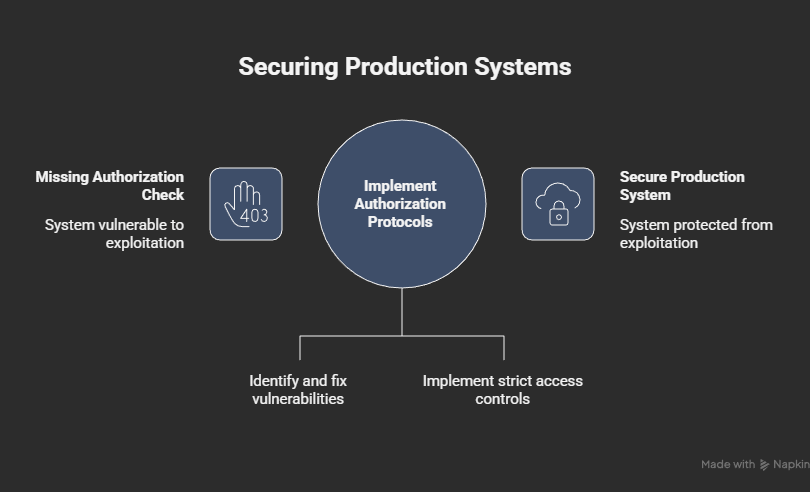
Phase 4: The Missing Authorization Check
The backend logic was effectively:
if export_type == "self":
    export_user_data()
else:
    export_all_data()
What was missing?
if user.role != "admin":
    deny()
That’s it.
One line.
Phase 5: Downloading the Crown Jewels
I accessed:
/exports/all_users.zip
Contents (anonymized):
- User emails
- Password hashes
- Tokens
- Internal IDs
- Logs
- Admin metadata
This was production data.
No exploit chain.
No escalation.
Just a missing check.
Phase 6: Chaining the Damage (Realistic Impact)
With this data, an attacker can:
- 🔑 Offline crack weak passwords
- 🔓 Reuse tokens
- 🧠 Map internal systems
- 📧 Launch targeted phishing
- 🧨 Pivot into admin accounts
The breach doesn’t end at download.
It begins there.
Why Monitoring Didn’t Catch This
| Control | Why It Failed |
|---|---|
| Auth | User was logged in |
| WAF | No malicious payload |
| Logs | Looked like export |
| Alerts | “Valid request” |
| IDS | No exploit signature |
Security tools don’t detect missing logic.
Root Cause: The Real Problem
❌ What Actually Went Wrong
- Authorization enforced only in UI
- Duplicate endpoints with different checks
- No centralized access control
- “Internal feature” exposed publicly
- No negative testing
This wasn’t negligence.
This was architecture drift.
✅ The One Rule That Would’ve Prevented Everything
Authorization must be enforced centrally, not per endpoint.
Correct pattern:
@require_admin
def export_all_users():
    ...
No exceptions.
No “temporary” endpoints.
No shortcuts.
How I Hunt Bugs Like This (Final Playbook)
This is the complete mental model behind the entire series:
🔍 Step 1: Identify sensitive actions
- Export
- Delete
- Approve
- Refund
- Admin tools
🔍 Step 2: Look for alternate paths
- Old endpoints
- Mobile endpoints
- Internal APIs
- v2 / legacy routes
🔍 Step 3: Change intent, not payload
self→alluser→adminfalse→true
🔍 Step 4: Watch for silence
- No error
- No alert
- Just success
Silence is the vulnerability.
Severity Assessment
| Area | Impact |
|---|---|
| Data exposure | Catastrophic |
| Compliance | Violated |
| Trust | Lost |
| Recovery | Expensive |
Severity:
Critical – Full Production Data Breach
This is the kind of bug that ends careers.
Why This Is the Most Common Breach Pattern
Because:
- Teams grow fast
- Codebases sprawl
- Access control isn’t centralized
- “Temporary” features stay forever
- No one tests as a low-priv user
Attackers do.
Final Lessons (Read This Twice)
- ❌ Frontend checks mean nothing
- ❌ Authentication ≠ Authorization
- ❌ One missing check is enough
- ✅ Centralize access control
- ✅ Test with least privilege
- ✅ Assume attackers read your API better than you
You don’t hack systems.
You walk through doors developers forgot to lock.
No zero-days.
No exploits.
No noise.
Just logic.
 Spyboy blog