
 Posted by
 No strange messages sent.
No OTP popped up.
No warning notification.
No suspicious login alert.
And yet — your WhatsApp conversations could be quietly mirrored on someone else’s screen right now.
This isn’t paranoia.
This is one of the most silent and effective account takeover methods abusing WhatsApp’s own features.
No malware.
No hacking tools.
No password theft.
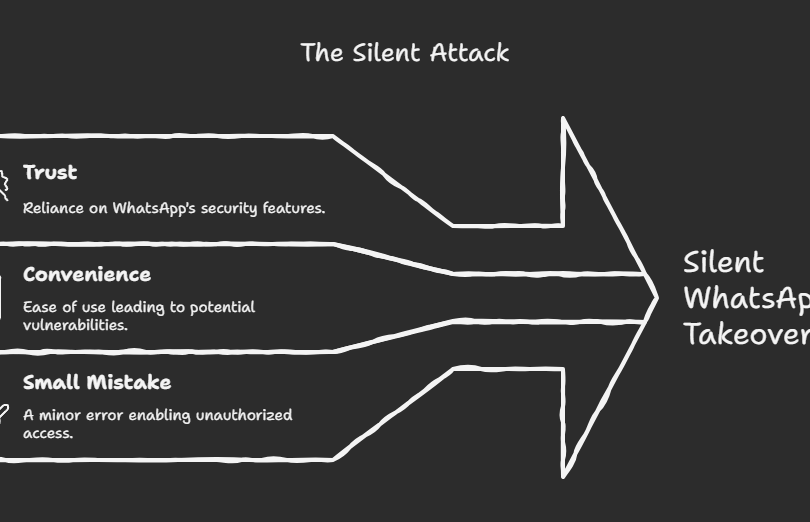
Just trust, convenience, and one small mistake.
🧠 The Dangerous Assumption Everyone Makes
Most users believe:
“If someone hacked my WhatsApp, I’d get an OTP or alert.”
That belief is wrong.
Modern WhatsApp compromises don’t attack login —
they attack device linking.
And once a device is linked, WhatsApp assumes:
“The user approved this.”
From that moment on, everything looks legitimate.
🔓 The Feature Being Abused: Linked Devices
WhatsApp allows you to:
- Use WhatsApp Web
- Sync chats across devices
- Stay logged in without your phone
This feature exists for convenience.
Attackers turned it into a surveillance tool.
🎭 The Silent WhatsApp Takeover (Step-by-Step)
This attack doesn’t look like hacking —
it looks like normal usage.
1️⃣ The Trust Setup
Victim receives a message:
“Hey, is this you in this photo?”
Often sent from:
- A hacked friend’s account
- A familiar contact
Trust is established immediately.
2️⃣ The Fake Page
The link opens:
- A fake image page
- A fake verification page
- A fake social preview
It asks for:
- Country
- Phone number
⚠️ No password request → victim feels safe.
3️⃣ The Legitimate WhatsApp Flow Is Triggered
Behind the scenes:
- WhatsApp generates a real device-linking code
- Meant only for the victim
The attacker doesn’t fake WhatsApp —
they use it.
4️⃣ The Fatal Step
The fake page says:
“Enter this code in WhatsApp to view the image”
Victim opens:
WhatsApp → Linked Devices → Link a Device
And enters the code.
💥 The attacker’s browser is now linked as a trusted device.
👁️ What Happens After the Device Is Linked
From this moment:
- Attacker sees incoming messages
- Attacker reads private chats
- Attacker downloads media
- Attacker monitors silently
WhatsApp does not notify you every time the linked device is active.
The attacker becomes a ghost.
🚫 Why You Don’t Get Any Warning
Because:
- You didn’t log in
- You didn’t fail authentication
- You didn’t bypass security
You used a feature.
From WhatsApp’s backend:
“Everything is normal.”
🧩 Why Victims Never Suspect WhatsApp
Victims usually think:
- Phone is safe
- SIM wasn’t swapped
- OTP never arrived
So they never check Linked Devices.
That’s exactly what attackers count on.
🔥 What Attackers Do While Watching Silently
Attackers may:
- Spy on personal conversations
- Gather sensitive info
- Monitor relationships
- Wait for the perfect moment
- Spread phishing links using your account
Some attackers stay connected for months.
🛡️ How to Check If Someone Is Reading Your WhatsApp (DO THIS NOW)
✅ Step 1: Check Linked Devices
Open:
WhatsApp → Settings → Linked Devices
If you see:
- Any unknown browser
- Any unfamiliar location
➡️ Log it out immediately.
✅ Step 2: Enable Two-Step Verification
Settings → Account → Two-Step Verification
Set a strong PIN.
This blocks many linking attacks.
❌ Step 3: Never Enter WhatsApp Codes from Websites
Rule:
WhatsApp codes belong inside WhatsApp — nowhere else.
If a website asks you to use one:
🚩 It’s an attack.
🚫 Step 4: Treat “I Found Your Photo” Messages as Malicious
Even if sent by a friend:
- Confirm on another platform
- Ask before clicking
Trust can be hijacked.
🧠 Why This Attack Is So Hard to Stop
Because it’s not a vulnerability.
There is:
- No exploit
- No CVE
- No policy violation
This is feature abuse + social engineering.
Security tools don’t stop:
“User-approved actions.”
🧠 For Security Researchers & Bug Hunters
This class of attack proves:
- UX is part of security
- Convenience creates attack surface
- Authorization is more dangerous than authentication
The cleanest attacks leave clean logs.
🔮 The Future of WhatsApp Attacks
Expect more attacks that:
- Avoid OTP entirely
- Abuse official flows
- Leave no evidence
- Feel “impossible” to victims
The attacker won’t break in.
They’ll be invited in.
⚠️ Final Reality Check
Someone could be reading your WhatsApp right now —
not because WhatsApp is insecure,
but because you were convinced to trust a feature.
No alert warned you.
No security failed.
The system worked exactly as designed.
🧨 The most dangerous WhatsApp attack doesn’t steal your account —
it quietly shares it.
📢 Share this post. Someone you know hasn’t checked Linked Devices in years.
Stay alert. Stay skeptical. Stay safe.
 Spyboy blog