 Posted by
 For decades, wars were fought with:
- Tanks
- Fighter jets
- Missiles
- Soldiers
Then something changed.
In the early 2010s, a new kind of weapon quietly appeared.
It didn’t explode.
It didn’t make headlines immediately.
It didn’t leave a smoking crater.
Instead…
It was hidden inside lines of computer code.
That code crossed borders without passports.
It bypassed fences.
It ignored checkpoints.
And according to widespread public reporting and analysis, it eventually reached one of the most heavily protected industrial facilities in the world.
Not through the internet.
Not through satellites.
But through something almost everyone has lying around their house.
A USB flash drive.
The malware was called:
Stuxnet
And many experts consider it the first cyberweapon to cause documented physical damage to industrial equipment.
It permanently changed how governments think about cyber warfare.
A Facility That Wasn’t Connected to the Internet
One of the biggest challenges facing attackers was simple.
The target systems weren’t directly connected to the public internet.
This is known as an air-gapped network.
The idea is straightforward:
If a system isn’t online, remote attackers have a much harder time reaching it.
Air gaps remain an important security measure for many sensitive environments.
So How Did Malware Get Inside?
This is the question that fascinated the cybersecurity world.
Researchers believe the malware likely entered through removable media such as USB drives used to transfer files between computers.
Think about it.
No internet connection.
No remote login.
No Wi-Fi.
Yet software still needed to move between systems.
The USB drive became the bridge.
Stuxnet Didn’t Attack Every Computer
This wasn’t ordinary malware.
It was incredibly selective.
Most malware infects as many systems as possible.
Stuxnet behaved differently.
It searched for very specific industrial environments.
If the conditions weren’t right…
It often remained inactive.
That level of precision shocked security researchers.
What Was It Looking For?
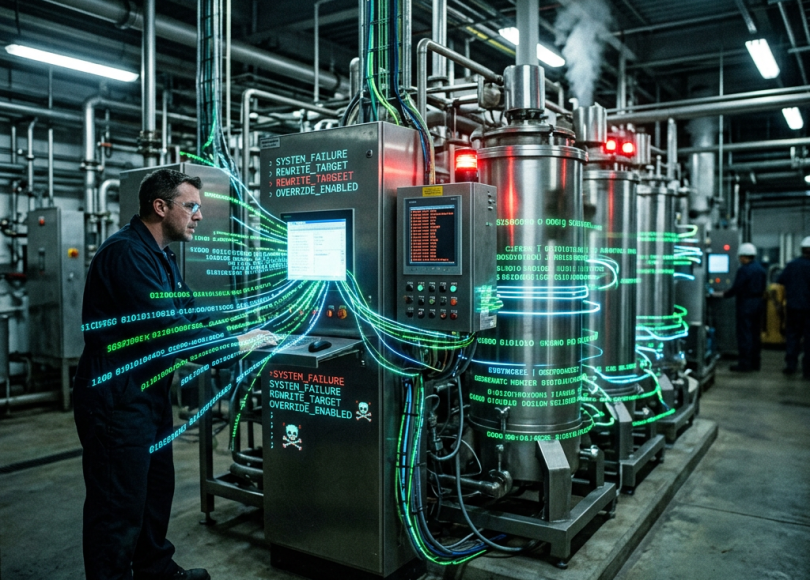
At the heart of the story were programmable logic controllers (PLCs).
PLCs are specialized industrial computers that help automate physical processes.
They’re used in:
- Manufacturing
- Water treatment
- Power generation
- Chemical plants
- Oil and gas facilities
Instead of displaying spreadsheets or playing videos, PLCs control machines.
Changing software on a PLC can change what a machine does.
The Most Dangerous Trick
Stuxnet reportedly did something few people thought possible.
It manipulated industrial equipment while simultaneously reporting normal operating conditions to monitoring systems.
Imagine a speedometer showing 60 km/h while the engine is actually running much faster.
Operators believe everything is normal.
Meanwhile, the machinery experiences abnormal stress.
This combination of manipulation and deception made the malware particularly sophisticated.
Why Security Experts Were Shocked
Most malware before Stuxnet focused on:
- Stealing data
- Encrypting files
- Sending spam
Stuxnet introduced another possibility:
Using software to influence physical equipment.
That represented a major shift.
Cybersecurity was no longer just about protecting information.
It was also about protecting infrastructure.
Four Zero-Day Vulnerabilities
Researchers found that Stuxnet used multiple zero-day vulnerabilities.
A zero-day vulnerability is a software flaw that is unknown to the vendor when attackers begin exploiting it.
They’re highly valuable because:
- No security update exists yet.
- Detection is difficult.
- Defenders have little time to react.
Using several zero-days in one piece of malware demonstrated an exceptional level of technical sophistication.
The Malware Escaped
One unexpected twist:
Although Stuxnet was designed for a specific target, copies eventually spread beyond the intended environment.
Security researchers around the world began analyzing it.
That’s how its existence became widely known.
Without that spread, the operation might have remained secret for much longer.
A New Era of Cyber Warfare
After Stuxnet, governments around the world began asking difficult questions:
- Could cyberattacks disable power grids?
- Could industrial systems be manipulated?
- How should nations respond to cyber operations?
- What counts as an act of war in cyberspace?
These questions remain relevant today.
Why Stuxnet Still Matters
The malware changed several fields at once:
- Industrial cybersecurity
- Government policy
- Cyber defense
- Critical infrastructure protection
It also highlighted the importance of securing systems that many people never think about.
Not laptops.
Not phones.
Factories.
Power stations.
Water facilities.
Transportation systems.
Lessons From Stuxnet
🔐 Air-gapped doesn’t mean invulnerable.
Physical access still matters.
💾 Removable media can create unexpected risks.
Even offline systems need security controls.
🏭 Industrial systems deserve cybersecurity.
Operational technology (OT) is just as important as IT.
🧠 Sophisticated attacks require sophisticated defenses.
Advanced threats evolve constantly.
🌍 Cyber operations now influence global security.
Software has become part of modern geopolitics.
Timeline
| Year | Event |
|---|---|
| Around 2010 | Stuxnet becomes publicly known after researchers discover it |
| Following months | Security researchers analyze the malware in depth |
| Following years | Governments and industries expand investment in industrial cybersecurity |
Frequently Asked Questions (FAQ)
What was Stuxnet?
Stuxnet was highly sophisticated malware designed to target specific industrial control systems.
Why is Stuxnet so famous?
It is widely regarded as the first malware publicly known to have caused physical damage to industrial equipment through software manipulation.
What is an air-gapped network?
An isolated network that is not directly connected to the public internet.
What is a zero-day vulnerability?
A previously unknown software flaw that attackers exploit before a security update is available.
Why is Stuxnet important today?
It demonstrated that cyber operations can have real-world physical consequences, changing how governments and industries approach cybersecurity.
Final Thoughts
Stuxnet wasn’t just another virus.
It marked the beginning of a new chapter in history.
For the first time, software demonstrated the potential to influence physical infrastructure on a global stage.
It blurred the line between digital operations and traditional conflict.
And it reminded the world of a lesson that remains true today:
The next major battle may not begin with tanks crossing a border.
It could begin with a single file copied onto a USB drive.
Discover more from Spyboy blog
Subscribe to get the latest posts sent to your email.
