
 Posted by
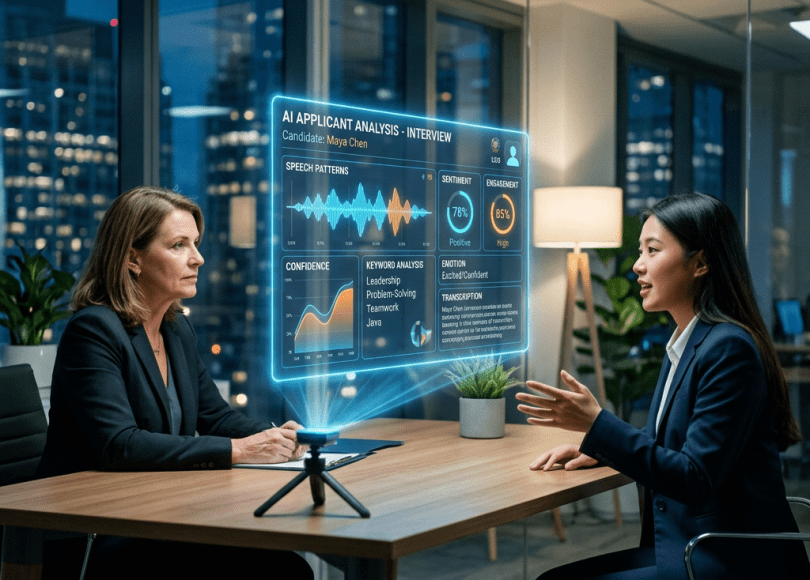
 Imagine sitting in a job interview.
You answer questions.
You smile.
You explain your experience.
You discuss your strengths and weaknesses.
Nothing unusual.
Except this time…
An AI system is also watching.
Analyzing:
- Your voice
- Your word choices
- Your speaking speed
- Your pauses
- Your facial expressions
- Your eye movements
And in some cases, attempting to estimate things like:
- Confidence
- Communication skills
- Engagement
- Personality traits
Sounds like science fiction.
But AI-powered hiring tools are already being used in various stages of recruitment.
And that raises a controversial question:
Can AI really judge people fairly?
Or are we creating a future where algorithms decide who gets opportunities?
In this deep dive, we’ll explore:
- 🤖 How AI is entering recruitment
- 🎤 AI-powered interview analysis
- ⚠️ The controversy surrounding AI hiring
- 🏢 Why companies are interested
- 🔍 What AI can and can’t actually determine
- 🔮 The future of job interviews
Because the next interviewer you meet…
May not be human.
Hiring Has Always Been Imperfect
For decades hiring decisions relied on:
- Human judgment
- Resumes
- Interviews
- References
The process has never been perfect.
Humans bring:
- Biases
- Assumptions
- Subjective opinions
Companies have long searched for ways to make hiring more efficient.
AI appeared to offer a solution.
Why Companies Want AI in Hiring
Recruiters often face:
- Thousands of applications
- Limited time
- Tight deadlines
AI promises:
- Faster screening
- Automated analysis
- Candidate ranking
- Resume filtering
From a business perspective, the appeal is obvious.
Speed.
Scale.
Efficiency.
What AI Actually Analyzes
Modern systems may analyze:
Resume content
Skills.
Keywords.
Experience.
Interview responses
Language patterns.
Communication style.
Assessments
Technical tests.
Skills evaluations.
Behavioral indicators
Engagement signals.
Response patterns.
Not every company uses every feature.
But the technology is evolving rapidly.
The Big Claim: Can AI Detect Lies?
This is where things become controversial.
Many researchers remain skeptical about technologies claiming they can reliably determine:
- Truthfulness
- Deception
- Intent
Human beings struggle to detect lies accurately.
AI doesn’t magically solve that challenge.
The science remains debated.
And experts continue arguing about what these systems can genuinely measure.
Why Candidates Are Nervous
Imagine knowing an algorithm might evaluate:
- Your speech
- Your behavior
- Your answers
Many applicants worry about:
- Transparency
- Fairness
- Accuracy
Especially when they don’t fully understand how decisions are made.
The Problem With Human Behavior
People communicate differently.
Some candidates:
- Speak quickly
- Speak slowly
- Avoid eye contact
- Have accents
- Feel nervous
Those differences don’t necessarily reflect:
Competence.
Yet algorithms may attempt to interpret them.
That’s where concerns arise.
The Rise of AI-Generated Candidates
Ironically, another challenge is emerging.
Candidates increasingly use AI to:
- Improve resumes
- Generate answers
- Prepare interviews
So now companies face a strange situation:
AI evaluating humans…
Who are using AI.
The hiring process is becoming an AI-versus-AI ecosystem.
Why Transparency Matters
Many applicants ask:
- What data is collected?
- How is it analyzed?
- How much influence does AI have?
These questions are becoming increasingly important.
Because trust requires understanding.
And many systems remain opaque.
The Future Could Be Hybrid
Most experts expect humans to remain involved.
Rather than replacing recruiters entirely, AI will likely assist with:
- Screening
- Organization
- Prioritization
Human judgment will still matter.
Especially for complex decisions.
Could AI Create New Biases?
One of the biggest concerns is:
Historical data.
If an AI learns from past hiring decisions…
It may also learn historical patterns.
Including undesirable ones.
This is why responsible AI development receives so much attention.
Another Hidden Problem: Candidates Start Optimizing for Algorithms
People adapt quickly.
If candidates know algorithms evaluate them:
They begin optimizing for algorithms.
This changes behavior.
Sometimes in ways nobody expected.
What Job Seekers Should Focus On
Despite all the hype:
Fundamentals still matter.
Skills.
Experience.
Communication.
Problem-solving.
AI may influence hiring.
But it doesn’t eliminate the value of real expertise.
Warning Signs AI Is Part of the Process
🚩 Automated interview platforms
Increasingly common.
🚩 One-way video interviews
May involve automated analysis.
🚩 Instant resume scoring
Likely algorithmic assistance.
🚩 AI-powered assessments
Growing rapidly.
🚩 Automated candidate rankings
Often AI-assisted.
How To Prepare for AI-Assisted Hiring
Now the important part.
🔐 1. Focus on Clear Communication
Humans and algorithms both value clarity.
🛡 2. Tailor Resumes Carefully
Relevance matters.
📱 3. Practice Video Interviews
Comfort improves performance.
🌐 4. Understand the Tools
Awareness reduces anxiety.
🚫 5. Don’t Depend Entirely on AI
Your skills still matter.
🔍 6. Build Genuine Expertise
Technology can’t replace competence.
Comparison: Traditional Hiring vs AI-Assisted Hiring
| Traditional Hiring | AI-Assisted Hiring |
|---|---|
| Human screening | Automated screening |
| Manual resume review | Algorithmic filtering |
| Subjective evaluation | Data-driven analysis |
| Slower process | Faster process |
| Limited scale | Massive scale |
The Bigger Problem: Who Gets to Judge Human Potential?
This is the real debate.
Not:
Can AI analyze data?
It can.
The question is:
Should algorithms help determine opportunity?
That’s a much harder question.
And society is still figuring out the answer.
Final Thoughts: The Future Interview Might Be Watching More Than You Think
AI is transforming hiring.
That’s no longer speculation.
It’s happening.
The technology promises:
- Efficiency
- Scale
- Consistency
But it also raises:
- Ethical questions
- Fairness concerns
- Transparency challenges
The future of hiring may not be humans versus AI.
It may be humans and AI working together.
The challenge will be ensuring that opportunity remains fair.
Because at the end of the day…
The most important thing a hiring system evaluates isn’t data.
It’s people.
Frequently Asked Questions (FAQ)
❓ Can AI conduct job interviews?
AI can assist with interview processes and candidate assessments, though implementation varies.
❓ Can AI detect lies?
Claims about reliable lie detection remain controversial and heavily debated.
❓ Do companies use AI in hiring?
Many organizations use AI-assisted tools for screening and recruitment workflows.
❓ Is AI replacing recruiters?
Most current systems assist rather than completely replace human recruiters.
❓ Can AI be biased?
Bias remains an important concern in AI systems.
❓ How should candidates prepare?
Focus on skills, communication, and understanding modern hiring tools.
Final Call to Action
Before your next interview:
- Learn how AI is used in hiring
- Practice clear communication
- Build genuine skills
- Don’t rely entirely on AI-generated answers
- Stay informed about recruitment technology
Because in the future…
You may not be the only one being evaluated.
Discover more from Spyboy blog
Subscribe to get the latest posts sent to your email.

Great article! As an unemployed construction tradesman (red sealed journeyman Interior Systems Mechanic), I recently went through a course learning to more efficiently use AI for job applications. Highly debated was an understatement. Lol
-Resumes being skipped due to letting AI choose applicants
-Many qualified applicants getting passed over just for one or two typos
-checking applications for false claims of work/school experience
Many qualified and experienced workers are getting lost in the ai slop that is the hiring process, at least here in Canada, is what I’m seeing.
Thank you for this excellent breakdown, I look forward to your next! 👍
LikeLike