 Posted by
 A few years ago, scam calls were easy to spot.
You’d hear:
- Strange accents
- Robotic voices
- Awkward scripts
- Obvious red flags
Most people hung up immediately.
But AI changed the rules.
Today, scammers can generate voices that sound remarkably similar to real people.
Not celebrities.
Not politicians.
Your friends.
Your family.
Your coworkers.
And in some cases, only a short audio sample may be needed to create a convincing imitation.
That means the next emergency phone call you receive might not be what it seems.
In this deep dive, we’ll uncover:
- 🎙 What AI voice cloning actually is
- 🕵️ How scammers use cloned voices
- ⚠️ Real-world scams already happening
- 📱 Where criminals get voice samples
- 🔐 Why traditional trust signals are failing
- 🛡 How to protect yourself and your family
Because for the first time in history…
Hearing a familiar voice may no longer prove who’s speaking.
What Is AI Voice Cloning?
AI voice cloning uses machine learning to:
- Analyze speech patterns
- Learn pronunciation
- Mimic tone
- Reproduce accents
- Copy speaking style
The result?
A synthetic voice that can sound surprisingly close to the original person.
Modern systems have improved dramatically in recent years, making voice generation more realistic and accessible than ever before.
Why This Is Different From Traditional Scams
Old scams relied on:
- Fear
- Urgency
- Deception
AI scams add something new:
Familiarity
Humans naturally trust familiar voices.
If you hear your child say:
“Mom, I need help.”
Your brain reacts emotionally before logically.
That’s exactly what scammers want.
The Most Common AI Voice Scam
Imagine this:
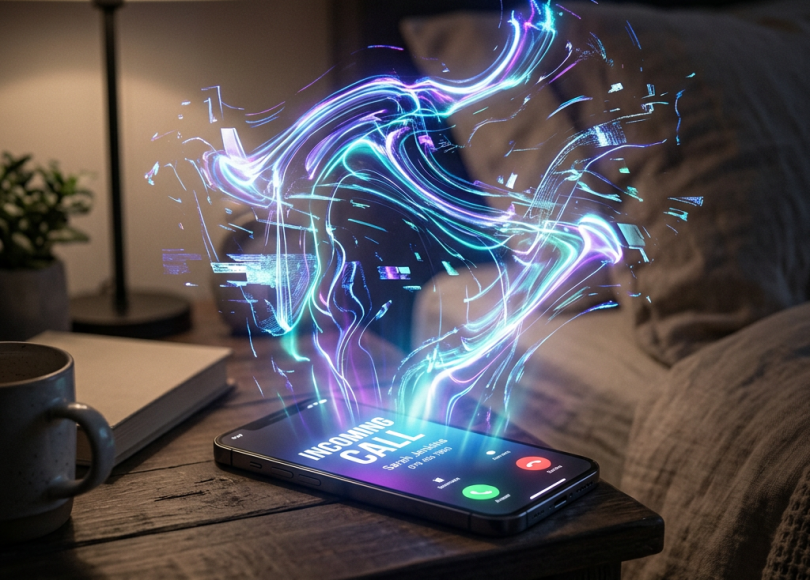
Your phone rings.
You answer.
A voice sounding exactly like your son says:
“Dad, I’ve been in an accident.”
Then:
“Please don’t tell anyone yet.”
“I need money immediately.”
People panic.
People stop thinking critically.
People act emotionally.
That emotional response is the attack.
Where Scammers Get Voice Samples
Many people publish voice recordings every day:
- TikTok videos
- Instagram Reels
- YouTube content
- Podcasts
- Voice notes
- Interviews
- Livestreams
Each recording potentially becomes training material.
Most people never consider this.
Because they assume:
“It’s just a video.”
But audio contains identity information too.
Social Media Made Voice Collection Easy
Years ago, collecting someone’s voice was difficult.
Today?
People voluntarily upload hours of audio.
Public content creates enormous opportunities for:
- Analysis
- Imitation
- Voice modeling
The internet became a giant audio library.
Businesses Are Becoming Targets Too
Voice cloning isn’t only targeting families.
Companies increasingly worry about:
- Executive impersonation
- Financial fraud
- Fake approval requests
- Employee manipulation
Imagine receiving a call that sounds exactly like your CEO.
Would you question it?
Many people wouldn’t.
Why Voice Is Such a Powerful Trust Signal
Humans evolved to trust:
- Faces
- Voices
- Familiarity
For decades:
Voice verification felt reliable.
If it sounded like your friend…
It probably was your friend.
AI challenges that assumption.
The Hidden Danger: Voicemail Messages
Many people have public voicemail greetings.
Examples:
“Hi, you’ve reached John…”
Those recordings may reveal:
- Name
- Voice characteristics
- Speaking style
Small pieces of information become valuable when combined.
Why Older Adults Are Often Targeted
Many AI voice scams target:
- Parents
- Grandparents
- Relatives
Because emotional urgency works.
Scammers often create stories involving:
- Accidents
- Arrests
- Medical emergencies
- Travel problems
The goal isn’t technical compromise.
The goal is emotional manipulation.
The Technology Will Keep Improving
Current voice cloning is already impressive.
Future systems will likely become:
- Faster
- Cheaper
- More realistic
- More accessible
That means awareness becomes increasingly important.
Because technical quality improves every year.
How To Tell If a Voice Is Real
This is becoming harder.
Which is exactly why old verification habits matter.
Instead of trusting the voice:
Verify the situation.
Call back.
Use another contact method.
Confirm independently.
Trust should move from:
Voice recognition
To:
Verification.
Warning Signs of an AI Voice Scam
🚩 Immediate urgency
Scammers want fast decisions.
🚩 Requests for money
Major warning sign.
🚩 Requests for secrecy
Huge red flag.
🚩 Emotional pressure
Designed to bypass critical thinking.
🚩 Refusal to verify identity
Always suspicious.
How To Protect Yourself and Your Family
Now the important part.
🔐 1. Create a Family Safe Word
Establish a private verification phrase.
If an emergency occurs:
Use the phrase.
Simple.
Effective.
🛡 2. Verify Through Another Channel
Receive a strange call?
Call back independently.
📱 3. Educate Family Members
Especially:
- Parents
- Grandparents
- Teenagers
🌐 4. Limit Public Audio When Possible
Think carefully about what becomes public.
🚫 5. Never Send Money Based Only on a Phone Call
Always verify first.
🔍 6. Slow Down
Scammers depend on panic.
Take a moment.
Think.
Verify.
Comparison: Traditional Scam Calls vs AI Voice Scams
| Traditional Scams | AI Voice Scams |
|---|---|
| Unknown caller | Familiar voice |
| Obvious scripts | Personalized stories |
| Easy to detect | More convincing |
| Generic approach | Emotional targeting |
| Limited realism | Increasingly realistic |
The Bigger Problem: Trust Is Being Redefined
For decades we trusted:
- Phone calls
- Voices
- Familiar sounds
AI is changing those assumptions.
The challenge isn’t technology.
The challenge is:
Knowing when trust should require verification.
Because soon:
Hearing someone may no longer mean they’re actually speaking.
Final Thoughts: The Voice You Trust Might Not Be Real
AI voice cloning isn’t science fiction anymore.
It’s here.
And while the technology has legitimate uses, scammers are already exploring ways to abuse it.
The most important lesson?
Stop treating voices as proof of identity.
Because the next generation of scams won’t try to trick your computer.
They’ll try to trick your emotions.
And that’s often much easier.
Frequently Asked Questions (FAQ)
❓ Can AI really clone someone’s voice?
Yes. Modern AI systems can generate synthetic voices that imitate real speech patterns and characteristics.
❓ How much audio is needed for voice cloning?
Requirements vary by system, but modern tools can often work with surprisingly small audio samples.
❓ Are AI voice scams increasing?
Security experts and law enforcement agencies have warned about growing use of AI-generated voices in fraud schemes.
❓ Can I tell if a voice is AI-generated?
Sometimes, but it is becoming increasingly difficult as technology improves.
❓ What is the best defense against voice cloning scams?
Independent verification through another communication channel.
❓ Should families create verification passwords?
Yes. A family safe word or verification phrase can help prevent impersonation scams.
Final Call to Action
Right now:
- Create a family verification phrase
- Warn relatives about AI voice scams
- Stop trusting phone calls blindly
- Verify emergencies independently
- Share this article with parents and grandparents
Because in 2026…
The most dangerous scam call may sound exactly like someone you love.
Discover more from Spyboy blog
Subscribe to get the latest posts sent to your email.
