 Posted by
A viral video can do more than entertain people. It can change how millions understand another country, influence public opinion, damage reputations, deepen political divisions and make a fabricated story appear real.
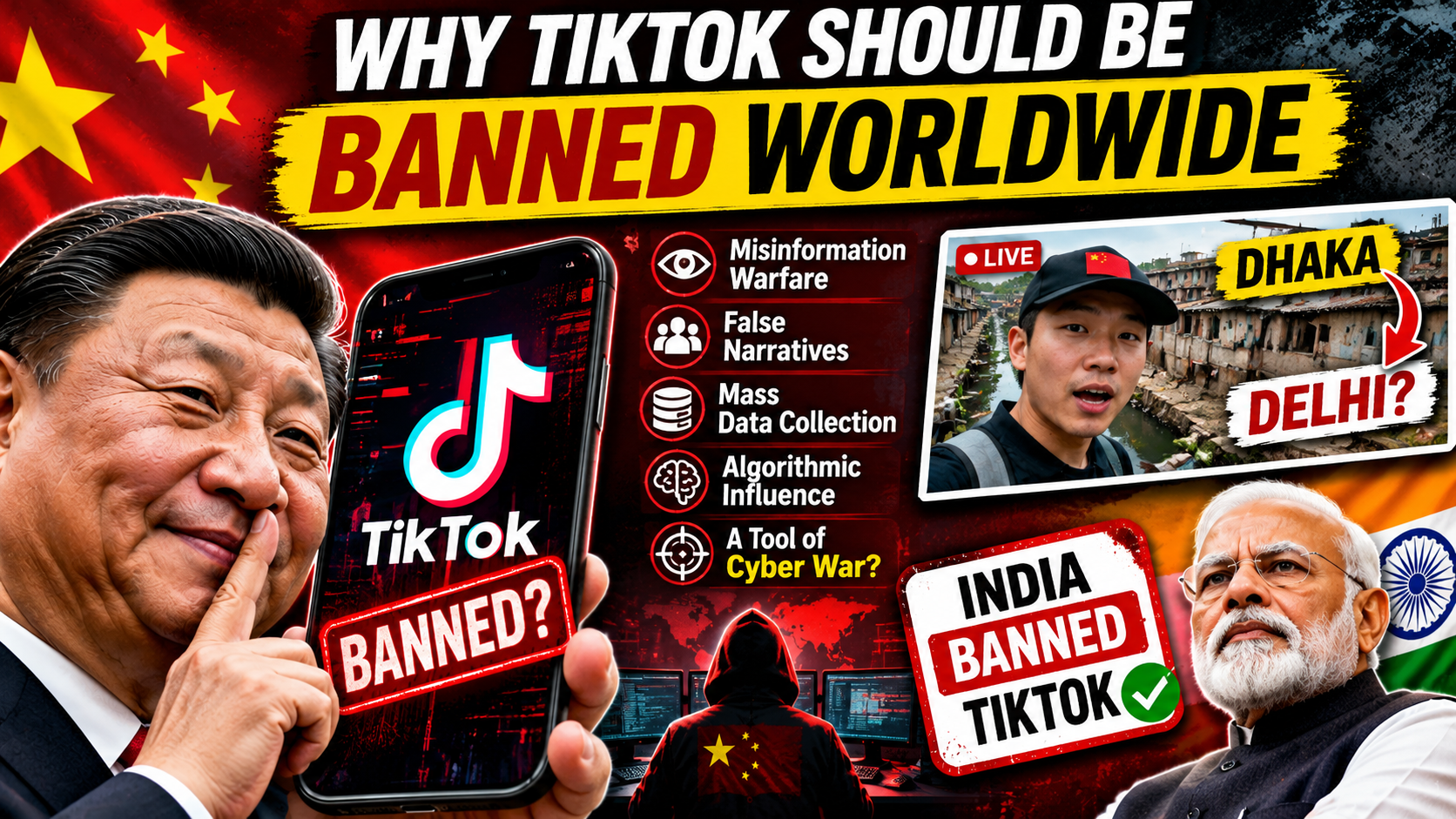
That is why the controversy over Chinese vloggers allegedly presenting locations in Dhaka, Bangladesh, as parts of New Delhi deserves attention beyond the usual debate about social media. It raises a bigger cybersecurity question: what happens when a platform with enormous reach becomes a channel through which misleading narratives can spread across borders?
TikTok sits at the centre of this debate. Its ownership, its relationship with China’s regulatory environment, the differences between TikTok and China’s domestic platform Douyin, and concerns about data access and influence operations have led governments to examine whether the platform creates national-security risks.
But there is an important distinction: a platform can create opportunities for manipulation without every misleading video being part of a centrally directed government operation. The evidence for a particular influence campaign must be established, not assumed.
This article examines the security concerns, the Dhaka–Delhi example, India’s 2020 TikTok ban, the difference between TikTok and Douyin, and whether banning the app is the only realistic response.
1. The Dhaka–Delhi controversy: when a location becomes a weapon
In November 2026, reports from Bangladesh and India brought an unusual form of online misinformation into public view.
According to reporting by Bangladeshi newspaper Prothom Alo, Chinese nationals had been filming in economically disadvantaged neighbourhoods of Dhaka, including areas around Uttara Sector 12 and Tekpara. The footage was reportedly presented to online audiences as scenes from New Delhi, accompanied by derogatory descriptions of living conditions, sanitation and local food.
The reports described more than 150 Chinese nationals being involved in filming activity over a period of months. Indian media subsequently reported on the allegations, and India’s Ministry of External Affairs addressed the issue publicly on November 10. Spokesperson Randhir Jaiswal called attempts to present a distorted picture of another country unfortunate and urged the authorities concerned to take action. TBS News+3
This is more than an argument about a misleading travel video.
Consider what the viewer is being shown:
- A camera records a real neighbourhood in Bangladesh.
- The creator labels the location as New Delhi.
- The creator adds commentary designed to make the location appear to represent Indian living conditions.
- The video is livestreamed or uploaded to an audience that may have no independent way to verify the location.
- Viewers may share the footage, discuss it and form opinions about India based on the false attribution.
The footage itself does not have to be fabricated. The buildings, roads, people and surroundings may all be real. The deception happens through the context attached to them.
This is an important lesson in modern information security: a genuine image can be used to construct a false story.
Why this is an OSINT and cybersecurity issue
An investigator would approach this as a location-verification problem.
They could examine:
- Street signs, shop names and local-language writing.
- Road layouts, buildings and landmarks.
- Geolocation clues visible in individual video frames.
- Upload times and livestream schedules.
- Whether the same footage appears on multiple accounts.
- Whether accounts share captions, hashtags, scripts or unusual posting patterns.
- Whether the videos are being reposted across several platforms.
The purpose would be to establish what happened, where it happened, who published the content and whether there is evidence of coordination.
However, there is an important limit. The reporting establishes allegations about misleading livestreams and a large number of people reportedly involved. It does not, by itself, prove that the Chinese government ordered or funded the activity, or that TikTok distributed those particular videos. The reporting identifies Chinese platforms, particularly Douyin and WeChat, as channels used for the livestreams. We should not casually relabel those platforms as TikTok.
That distinction actually makes the story more useful: it demonstrates how information operations can move through an ecosystem of platforms, influencers, reposting accounts and audiences.
2. What exactly is information warfare?
Traditional warfare focuses on physical territory, military capabilities, logistics and infrastructure. Cyber warfare expands the battlefield into computer networks, communications systems, digital infrastructure and information environments.
Information warfare focuses on influencing what people believe, how they interpret events and how they respond.
It can involve:
- Disinformation: deliberately spreading false or misleading information.
- Misinformation: false information shared without necessarily intending to deceive.
- Propaganda: communication designed to influence attitudes or behaviour.
- Impersonation: pretending to be a person, organisation or source that you are not.
- Coordinated inauthentic behaviour: accounts working together while hiding their real identities, relationships or intentions.
- Algorithmic amplification: exploiting recommendation systems to increase the reach of selected content.
These techniques are not exclusive to China, TikTok or any single government. States, political groups, commercial operators, scammers and independent actors can all use them.
The cybersecurity connection is that the target is not always a computer. Sometimes the target is the information environment surrounding millions of people.
Imagine a coordinated campaign that publishes hundreds of short videos showing unrelated locations, each falsely labelled as belonging to a rival country. The videos might use different accounts, different faces and different captions. But if the objective is to create a consistent impression, the campaign can still be effective.
No malware is necessary. No server needs to be hacked. No password needs to be stolen.
The attack surface is public perception.
3. Why TikTok deserves special scrutiny
TikTok is not simply a place where people upload dance videos. It is a large recommendation-driven media platform.
Its most important feature is the personalised For You feed. Users do not need to follow an account to encounter its content. The recommendation system can introduce videos from unfamiliar creators based on signals such as viewing behaviour and other engagement patterns.
This creates a powerful distribution mechanism.
A video can reach people who have never heard of the person who made it. A creator does not necessarily need a large existing following to attract attention. And a misleading video can be presented to viewers who have little context about the location, language or political situation being discussed.
That does not mean TikTok automatically promotes false information. It means that the design of a recommendation-driven platform can make the rapid spread of misleading content a serious risk.
The European Commission has examined this issue directly. In December 2024, it opened formal proceedings against TikTok over suspected failures to properly assess and mitigate systemic risks to election integrity, including risks connected to recommendation systems and coordinated manipulation. The opening of proceedings was an investigation, not a final finding that TikTok had violated the law. Shaping Europe’s digital future+1
The Commission had also requested information about how TikTok assessed risks arising from its recommendation systems and the possible spread of harmful content. Shaping Europe’s digital future+1
The concern is not limited to one country or one political viewpoint. Any platform capable of rapidly distributing content to a large audience can become a target for manipulation.
4. TikTok and Douyin: two apps, one parent company
One of the most frequently misunderstood parts of this debate is the relationship between TikTok and Douyin.
Both are owned by ByteDance, but they are separate applications operating in different markets.
| Feature | TikTok | Douyin |
|---|---|---|
| Primary market | International markets | Mainland China |
| Parent company | ByteDance | ByteDance |
| Availability | Many countries | Mainland China |
| Content rules | Local laws and platform policies | Chinese laws and platform policies |
| Recommendation system | Personalised feed | Personalised feed |
| Regulatory environment | Varies by country | China’s domestic regulatory system |
The Canadian Office of the Privacy Commissioner describes TikTok and Douyin as separate apps owned by the same parent company. It also notes that Douyin is not available outside China and TikTok is not available in mainland China. The two products share technological foundations but have developed under different rules and market conditions. Office of the Privacy Commissioner+1
The difference is not just the language
Douyin operates under China’s domestic regulatory framework. TikTok operates under the laws and regulatory requirements of the countries where it is available.
This matters because the two applications do not operate in identical information environments.
For example, the Canadian privacy regulator’s review describes political censorship and restrictions on sensitive searches on Douyin. It also discusses different approaches to content available to minors. These differences are documented in the regulator’s analysis; they should not be simplified into a claim that every video on one app is propaganda and every video on the other is unrestricted. Office of the Privacy Commissioner
The wider question is worth asking:
If two applications owned by the same company operate under different legal systems, how much transparency should users and regulators expect about their algorithms, content policies and data practices?
Users outside China should be able to understand:
- How recommendations are generated.
- Whether political or state-linked content receives special treatment.
- How accounts involved in coordinated manipulation are identified.
- What data is collected and who can access it.
- How moderation decisions are made.
- Whether researchers can independently examine platform behaviour.
Without meaningful transparency, outsiders have difficulty distinguishing ordinary viral content from organised manipulation.
5. The data-security problem: what does TikTok know about its users?
The misinformation debate is only one part of the TikTok security discussion.
Like other major social platforms, TikTok collects information needed to operate its service, personalise recommendations, measure engagement, prevent abuse and deliver advertising. Depending on the app version, permissions and user activity, this can include:
- Account details and profile information.
- Videos watched, liked, shared or commented on.
- Search and interaction history.
- Device information and identifiers.
- Approximate location information, and more precise location information where users enable relevant permissions.
- Network and diagnostic information.
- Contacts or other information when users choose to grant access.
The important question is not simply whether an app collects data. Most large platforms do. The questions are what is collected, how long it is retained, where it is stored, who can access it and under which legal conditions it can be disclosed.
Why ByteDance’s ownership matters
TikTok is owned by ByteDance, a company founded in China. This creates a national-security question that regulators have examined: could the Chinese government exert pressure on a company connected to Chinese operations, and could that pressure affect data access or platform operations?
The US Congressional Research Service has documented concerns raised by US policymakers about ByteDance’s ownership, potential access to user data, and the possibility that a platform could be used to influence public opinion. It also records TikTok’s position: the company has denied sharing US user data with the Chinese government. These are important distinctions between documented concerns, company statements and independently established facts. Every CRS Report+1
TikTok says it restricts employee access to user data through internal controls and authorisation procedures. Its own explanation of its security arrangements is available in its data-security statement. That is relevant evidence of the company’s stated policies, but a company’s own description is not a substitute for independent verification.
A 2025 joint investigation by Canadian privacy regulators also examined TikTok’s collection, use and disclosure of personal information. The investigation discussed international employee access to user information and the safeguards TikTok said it used. Office of the Privacy Commissioner
Why location and behavioural data matter
Think about what a large social platform can learn over time.
A single video view may reveal very little. Thousands of interactions can reveal much more:
- Which subjects interest a person.
- Which political or social topics they repeatedly engage with.
- Which accounts and communities they follow.
- When they are most active.
- Which content makes them stop scrolling.
- Which narratives they are likely to share or argue about.
This is not unique to TikTok. Other major platforms also collect extensive behavioural data.
But the combination of a huge user base, detailed behavioural profiles, recommendation systems and a company operating within a complex geopolitical environment creates a legitimate subject for security assessment.
The issue is not that every TikTok user is being individually monitored by a foreign government. That would be an unsupported claim. The issue is whether the platform’s governance and access controls provide sufficient protection against misuse at scale.
6. How a short-video platform could be used in an influence operation
Let’s look at a hypothetical example inspired by the Dhaka–Delhi controversy.
Suppose an organised group wants to create a negative impression of Country A among viewers in Country B.
It does not need to hack a government website or compromise a news organisation. It could use a much simpler content operation.
A hypothetical influence-operation workflow
- Select the footageRecord real locations that visually match the intended narrative, such as neglected streets, crowded markets or damaged infrastructure.
- Misrepresent the contextAttach the wrong city, country, date or explanation to the footage.
- Publish through multiple accountsDifferent accounts upload related clips, each reinforcing the same impression.
- Use emotional framingAdd mocking captions, provocative commentary or misleading comparisons.
- Encourage amplificationViewers comment, repost, argue and create response videos. The story may spread beyond the original audience.
- Move the narrative elsewhereClips are reposted to other social networks, messaging groups, blogs and discussion forums.
This is an illustrative threat model, not a claim that every step occurred in the Dhaka case.
Why this can be effective
A viewer scrolling through short videos may not investigate every location. They may see a caption, a confident presenter and a few seconds of footage, then accept the explanation.
The content can be especially persuasive when it confirms an existing stereotype or political belief.
This is where the problem becomes a cybersecurity issue: the attacker is exploiting trust, recommendation systems, platform design and the human tendency to accept convincing visual evidence.
The role of coordinated accounts
A coordinated operation may use accounts that appear independent. They can publish similar content, repeat claims, share hashtags or amplify one another.
But similar posts do not automatically prove coordination. Investigators need stronger indicators, such as:
- Repeated identical or near-identical footage.
- Shared unusual phrases or caption patterns.
- Closely synchronised posting times.
- Repeated links between accounts.
- Common infrastructure or account-management evidence, where lawfully available.
- Evidence of shared direction, payment or organisation.
A cybersecurity researcher should distinguish between a cluster of accounts that looks suspicious and a cluster for which coordination has actually been demonstrated.
That distinction protects the investigation from becoming another source of misinformation.
7. Is China using social media for global influence?
China’s international media and influence activities have been studied by researchers and policy organisations for years.
A 2022 Freedom House report, Beijing’s Global Media Influence, examined efforts by the Chinese government and its proxies to shape media narratives in multiple countries. It documented tactics including the distribution of state-backed content, pressure on media organisations, online harassment, fake accounts and disinformation campaigns. Its research covered 30 countries and the period from January 2019 to December 2021. Freedom House
This report is useful because it shows that concerns about influence operations did not begin with TikTok.
However, it does not establish that every Chinese content creator, influencer or social-media account is working for the Chinese state. Nor does it prove that the Dhaka–Delhi incident was directed by Beijing.
A careful assessment separates three different things:
- State media activity: content openly produced or distributed by state-owned or state-controlled media.
- Influence activity: attempts by state-linked or other organised actors to shape public discussion.
- Independent content creation: individuals publishing videos for entertainment, money, attention or personal reasons.
These categories can overlap, but they are not interchangeable.
The platform is an amplifier, not necessarily the origin
Even if an influence campaign starts somewhere else, a popular recommendation platform can help it reach a much larger audience.
For example, misleading content could originate on a domestic platform, be reposted to TikTok, then move to YouTube Shorts, Instagram Reels, Facebook and messaging applications.
This is why focusing only on one app can miss the wider problem.
The same video can travel through an entire digital ecosystem.
8. India’s 2020 TikTok ban: what actually happened?
India provides one of the most significant examples of a country blocking TikTok on national-security grounds.
On June 29, 2020, India’s Ministry of Electronics and Information Technology announced that it was blocking 59 mobile applications, including TikTok and WeChat.
The government invoked Section 69A of the Information Technology Act and cited concerns relating to sovereignty and integrity, defence, security of the state and public order. Its announcement referred to information that the applications were engaged in activities considered prejudicial to those interests. Press Information Bureau
This happened amid heightened India–China tensions following the deadly border clash in the Galwan Valley.
The ban was not limited to TikTok. The list included several other applications with Chinese links.
India subsequently announced additional blocking orders:
- June 29, 2020: 59 applications, including TikTok.
- September 2, 2020: 118 additional applications.
- November 24, 2020: 43 additional applications.
The official announcements are available through the Government of India’s Press Information Bureau. Press Information Bureau+2
Why the Indian decision mattered
India’s action demonstrated that a country could use its domestic legal framework to restrict access to a widely used foreign-owned application when its government considered the risks sufficiently serious.
It also raised a wider policy question: should national-security assessments of digital platforms consider only traditional technical vulnerabilities, or should they also examine data governance, ownership, foreign legal exposure and the ability to manipulate information distribution?
The Indian government’s position was that the applications posed risks to sovereignty, security and privacy. That is the stated rationale in the official notification. It should not be confused with a public technical audit proving every alleged risk in every app.
Was the ban a cybersecurity measure?
It was a national-security and digital-security measure carried out through a legal blocking mechanism.
A platform can create several types of risk at once:
- Data protection risks.
- Potential foreign access to sensitive information.
- Influence and information-manipulation risks.
- Risks to public order and national security.
A government may decide that a combination of these risks justifies restricting access. Whether a ban is proportionate or effective is a separate question that should be assessed through evidence and outcomes.
India’s decision is therefore an important case study, not automatic proof that every country should copy the same policy.
9. Other countries have raised concerns too
India was not alone in scrutinising TikTok.
Different governments have taken different approaches, ranging from restrictions on government devices to investigations, legislation and demands for changes in ownership or data governance.
United States: ownership and national-security concerns
The United States has debated TikTok’s ownership structure, data access and possible influence risks for several years.
The Congressional Research Service provides a useful overview of the legislative and national-security debate, including the 2024 law requiring ByteDance to divest TikTok or face restrictions under the law’s terms. The report also describes arguments made by policymakers and TikTok’s responses. Every CRS Report+1
Read: Congressional Research Service — TikTok and China’s Digital Platforms.
European Union: election integrity and recommendation systems
The European Commission’s December 2024 proceedings focused on TikTok’s handling of systemic risks to elections and civic discourse.
The investigation included questions about recommendation systems, coordinated inauthentic manipulation and political advertising. The Commission’s announcement made clear that opening proceedings was not a final determination of wrongdoing. Shaping Europe’s digital future+1
Read: European Commission — Proceedings against TikTok on election risks.
Canada: privacy investigation
Canadian privacy regulators conducted a joint investigation into TikTok’s privacy practices. Their 2025 findings examined the company’s handling of personal information, including its practices around collection, use and access. Office of the Privacy Commissioner
Read: Office of the Privacy Commissioner of Canada — TikTok investigation.
These examples show that the debate is not simply about whether people enjoy using TikTok. It is about whether a major platform should be subject to stronger safeguards when its ownership, data practices or recommendation systems create risks that governments believe could affect national security or democratic processes.
10. Should TikTok be banned in every country?
This is where the debate becomes more complicated.
There are arguments for restricting or banning TikTok, but there are also serious questions about whether a blanket ban is the most effective response.
A ban can reduce exposure to a particular platform’s risks within a country. It cannot eliminate the broader information-war problem.
Argument 1: National security should come before entertainment
A social-media application can be entertaining and still create security risks.
If a government believes that a platform’s ownership structure, data-access arrangements or content systems expose citizens to unacceptable risks, it may consider restricting it.
The fact that millions of people enjoy an application does not automatically make it safe.
Argument 2: Foreign influence operations can exploit recommendation systems
A recommendation system that rapidly distributes content can be attractive to people attempting to manipulate public discussion.
If a platform cannot adequately identify coordinated manipulation, disclose relevant information or respond quickly to harmful campaigns, regulators may consider stronger restrictions.
The European Commission’s investigation into TikTok’s election-related risks demonstrates that these concerns are being examined through formal regulatory processes, rather than being limited to political commentary. Shaping Europe’s digital future+1
Argument 3: Data sovereignty matters
Countries increasingly recognise that data is an important national resource.
Personal information, location data, behavioural profiles and other digital records can have security implications.
A government should be able to ask whether a foreign-owned platform provides adequate protections against unauthorised access and whether independent audits can verify those protections.
But there are counterarguments
A global ban is not a simple solution.
First, the problem is not unique to TikTok. Other social networks can also amplify misinformation, collect extensive user data and be manipulated by coordinated accounts.
Second, banning an application does not eliminate the content. Creators can move to other platforms, and audiences can encounter the same videos elsewhere.
Third, bans affect ordinary users. Creators, small businesses, artists and people who rely on a platform for income may be affected by restrictions.
Fourth, government blocking powers need safeguards. Restrictions should have a clear legal basis, transparent reasoning, proportionality and avenues for review. Otherwise, national-security arguments could be used too broadly.
Fifth, technical solutions may address some risks without a complete ban. Independent security audits, data-access restrictions, transparency requirements and enforceable penalties can provide alternatives in some circumstances.
The real policy question is not simply whether TikTok is good or bad. It is what level of risk a country is prepared to accept and what evidence it requires before imposing restrictions.
11. If not a ban, what should governments do?
There are several measures governments can consider. They do not all have to be used together, and their effectiveness depends on enforcement.
| Measure | What it addresses |
|---|---|
| Independent security audits | Examines data handling, access controls and technical safeguards |
| Data localisation or strict access controls | Limits where sensitive user data can be stored and accessed |
| Ownership and governance transparency | Makes control, influence and accountability easier to examine |
| Algorithmic transparency | Helps researchers assess how content is recommended |
| Political-content disclosures | Helps audiences identify paid or state-linked messaging |
| Coordinated-account detection | Identifies suspicious networks and artificial amplification |
| Independent research access | Allows qualified researchers to study platform risks |
| Temporary restrictions | Can limit exposure during a specific, substantiated security threat |
| Full blocking | Removes access to the service when less restrictive measures are considered inadequate |
Require independent audits, not just company promises
A platform should not be able to resolve national-security concerns simply by publishing a blog post saying that user data is safe.
Independent auditors should be able to examine:
- Data access permissions.
- Employee access logs.
- Encryption and key-management practices.
- Data retention and deletion.
- Third-party sharing.
- Cross-border access arrangements.
- Security incident response.
- Controls over recommendation and moderation systems.
Audits should be conducted by qualified independent organisations under enforceable rules. The findings should be disclosed to regulators and, where possible, made public in a meaningful form.
Make recommendation systems more transparent
Users should have a better understanding of why particular political or sensitive content is being recommended to them.
Platforms should provide meaningful information about:
- Whether content is sponsored.
- Whether an account is officially affiliated with a state organisation.
- Whether a video has been materially manipulated.
- Whether a recommendation is personalised.
- Whether coordinated manipulation has been detected.
Transparency does not mean publishing every detail of a proprietary algorithm. It means providing enough information for regulators and independent researchers to evaluate systemic risks.
Make platforms accountable for coordinated manipulation
A platform should not wait until a misleading campaign has reached millions of people before responding.
It should have systems to detect suspicious networks, preserve relevant evidence, investigate coordinated behaviour and publish meaningful transparency reports.
The goal should be to identify deceptive behaviour, not simply remove content because it criticises a government or expresses an unpopular opinion.
That distinction is essential for protecting freedom of expression.
12. How cybersecurity researchers can investigate a suspected influence campaign
This is where the story becomes especially interesting for OSINT researchers and cybersecurity enthusiasts.
The Dhaka–Delhi controversy offers a practical example of how open-source investigation can be used to test claims about online manipulation.
A researcher should not begin by assuming that a government is behind a campaign. They should begin by collecting evidence.
Step 1: Preserve the original content
When a suspicious video appears:
- Record the original post URL.
- Note the account name and public profile information.
- Record the publication date and time, including the time zone.
- Save a screenshot of the public post.
- Preserve the video where lawful and permitted.
- Record any changes to the caption or description.
Do not rely only on a repost. Original uploads provide stronger evidence about publication time and source.
Step 2: Verify the location
Use visible clues to determine whether the claimed location matches the footage.
Useful resources include:
- Google Maps — street layouts and landmarks.
- Google Earth — satellite imagery and geographical comparison.
- OpenStreetMap — open geographical data.
- Google Lens — visual search.
- InVID-WeVerify — video verification tools.
A researcher might identify a shop sign, compare the road layout and then check whether the surrounding buildings match the claimed city.
For the Dhaka example, a verified local sign or recognisable landmark could help establish that footage presented as New Delhi was actually recorded in Bangladesh.
Step 3: Extract video frames
A video contains many individual frames. Investigators can extract selected frames and examine them separately.
For a local investigation, FFmpeg is useful:
ffmpeg -i suspicious_video.mp4 \ -vf "fps=1/5" \ extracted_%04d.jpg
This extracts one frame every five seconds.
You can then inspect individual frames for:
- Street signs.
- Shop names.
- Local scripts.
- Vehicle registration clues.
- Building numbers.
- Landmarks.
- Reflections and other visual details.
Step 4: Compare multiple uploads
If multiple accounts publish similar videos, compare:
- Video hashes.
- Perceptual image similarity.
- Captions.
- Hashtags.
- Publication times.
- Repeated editing patterns.
- Shared links and references.
A simple SHA-256 hash can identify byte-for-byte identical files:
import hashlibdef sha256_file(path): digest = hashlib.sha256() with open(path, "rb") as file: for chunk in iter(lambda: file.read(65536), b""): digest.update(chunk) return digest.hexdigest()video_hash = sha256_file("suspicious_video.mp4")print("SHA-256:", video_hash)
A limitation: two videos can contain the same footage but have different hashes because one was compressed, cropped or edited. Perceptual hashes and frame similarity can help identify those relationships, but they are not proof of common authorship.
Step 5: Examine coordination indicators
A researcher can build a timeline of public posts and look for patterns.
For example:
| Observation | What it might indicate |
|---|---|
| Many accounts publish the same unusual caption | Possible shared source or coordination |
| Several accounts upload the same clip within minutes | Possible organised distribution |
| Repeated footage from the same location | Shared filming activity or content reuse |
| Identical edits and audio | Common production workflow |
| Accounts repeatedly amplify one another | Possible coordinated network |
None of these indicators alone proves state direction.
The strongest investigation combines multiple independent sources and clearly separates observed facts from hypotheses.
Step 6: Publish a reproducible report
A credible OSINT report should include:
- The original claim.
- The evidence collected.
- The verification method.
- The location and source findings.
- A timeline.
- Confidence levels.
- Limitations and unresolved questions.
This is how investigators can challenge misinformation without creating more misinformation in the process.
13. What ordinary users can do to avoid becoming part of an information operation
You do not need to be a cybersecurity professional to recognise suspicious content.
A few simple habits can reduce the likelihood of being manipulated.
Check the location before believing the caption. A video labelled as Delhi may have been filmed in Dhaka, Karachi, Kathmandu or somewhere else entirely.
Look for the original source. A reposted clip may have lost important context.
Be careful with emotionally provocative content. If a video is designed to make you immediately angry, disgusted or triumphant, pause before sharing it.
Search for independent reporting. A major event should not depend entirely on one anonymous social-media account for verification.
Check dates. Old footage is frequently presented as a new event.
Look for manipulated context. A real video can still be misleading because of its caption, location, translation or editing.
Do not amplify unverified claims. Sharing a misleading video to criticise it can still increase its reach.
For cybersecurity professionals, this is an increasingly important form of digital literacy. Technical security is not just about protecting devices and accounts; it also includes understanding how information can be manipulated.
14. The bigger threat: the next information operation may not use TikTok
It would be a mistake to assume that banning one application solves the problem.
Imagine TikTok disappears from a particular country tomorrow. What happens next?
The same creators could upload videos to YouTube Shorts. Others could publish them on Instagram Reels. Some could distribute them through Telegram, WhatsApp or other messaging platforms.
An organised network could create new accounts, use different names and move its audience.
The technology changes, but the strategy remains the same.
This is why countries need a wider digital-security strategy that includes:
- Protection of personal data.
- Independent oversight of major platforms.
- Cyber threat intelligence.
- Digital and media literacy.
- Rapid fact-checking during major incidents.
- Cooperation between governments and independent researchers.
- Stronger transparency requirements for platforms.
- Clear procedures for responding to foreign influence operations.
A country’s digital security cannot depend entirely on whether one particular application is available.
Conclusion: Is TikTok a national-security risk, and is banning it the only answer?
TikTok deserves serious scrutiny because of its ownership, data practices, recommendation systems and the possibility that a platform with enormous reach could be exploited to manipulate public discussion.
The concerns are not limited to India. Governments and regulators in the United States, Europe and Canada have examined different aspects of the platform, from data protection to election integrity and foreign influence risks.
India’s 2020 decision to block TikTok and other applications demonstrated one way a government can respond when it considers a digital service a threat to national security.
But the Dhaka–Delhi controversy adds another dimension to the discussion.
It shows how footage from a real location can be given a false identity and used to create a misleading impression of another country. It also shows why OSINT, video verification and platform accountability matter.
One important clarification remains: reports about the Dhaka livestreams identified Douyin and WeChat as platforms used by the vloggers. They do not establish that the same operation was conducted through TikTok or directed by the Chinese government. That evidence should not be invented to strengthen an argument.
The broader risk, however, is real enough to deserve serious attention: digital platforms can be exploited to distribute misleading narratives across national borders, and their recommendation systems can make those narratives visible to people who have no easy way to verify them.
The real question is not whether one social-media app should be blamed for every online falsehood. It is whether countries have adequate safeguards against foreign-controlled data risks, coordinated manipulation and opaque recommendation systems.
A ban is one possible policy response. Stronger regulation, independent audits, transparency and enforceable accountability are others. The appropriate response depends on the evidence, the severity of the risk and whether less restrictive safeguards can actually work.
Because the next information operation may not be a viral TikTok video.
It could be a livestream, an AI-generated clip, a fake news website, a network of coordinated accounts or a video that looks completely real — filmed in one country, labelled as another, and shared millions of times before anyone checks where it came from.
In modern cyber warfare, sometimes the target is not your computer. It is what you believe.
Further reading and sources
The following reports and official documents provide background and supporting evidence for the issues discussed in this article.
1. The Dhaka–Delhi controversy
- Prothom Alo — India wants action against Chinese vloggers filming in Dhaka
- The Business Standard — India urges Bangladesh to act over Dhaka videos
- The New Indian Express — Report on the alleged campaign
- The Week — India responds to the alleged false narratives
2. India’s TikTok ban
- Government of India — Ban on 59 mobile applications, June 2020
- Government of India — Blocking of 118 applications, September 2020
- Government of India — Blocking of 43 applications, November 2020
3. TikTok, Douyin and data security
- Office of the Privacy Commissioner of Canada — TikTok and Douyin comparison
- Congressional Research Service — TikTok and China’s Digital Platforms
- Canadian privacy regulators — Joint TikTok investigation
- TikTok — How the company says it protects user data
4. Influence operations and election integrity
- European Commission — Formal proceedings against TikTok over election risks
- European Commission — Request for information on TikTok and information manipulation
- Freedom House — Beijing’s Global Media Influence
This article distinguishes documented government actions and regulatory investigations from allegations and analysis. The existence of a security concern or an investigation should not be treated as proof that a particular government directed a specific social-media campaign.
Discover more from Spyboy blog
Subscribe to get the latest posts sent to your email.
