
 Posted by
 You Have Just Been Scammed. Don’t Panic. Act.
Your phone vibrates.
₹10,000 debited.
Then another message.
₹50,000 debited.
Then another.
₹1,00,000 debited.
Your heart drops.
Maybe you clicked a link.
Maybe you installed an APK.
Maybe someone pretending to be from your bank called you.
Maybe you were told your SIM would be blocked.
Maybe someone threatened you with a “digital arrest.”
Maybe you scanned a QR code.
Maybe you approved a UPI request.
Maybe you were promised a job, investment return, loan, refund, cashback or prize.
Whatever happened, one thing matters more than almost anything else:
TIME.
Money stolen through digital fraud can move rapidly through accounts and payment channels.
The longer you wait, the more difficult recovery may become.
India’s National Cyber Crime Reporting Portal specifically directs victims of financial cyber fraud to report immediately through 1930, and the government describes the Citizen Financial Cyber Fraud Reporting and Management System as a mechanism for immediate reporting intended to help stop fraudulent funds from being siphoned away.
So if you’ve just lost money:
Don’t spend the next hour trying to understand exactly how the scam worked. Start the reporting process first.
You can investigate the scam afterward.
🚨 IF YOU WERE JUST SCAMMED: DO THESE THINGS NOW
Step 1 — Stop Talking to the Scammer
Don’t negotiate.
Don’t threaten them.
Don’t tell them you’re reporting them.
Don’t send another ₹1 to “unlock” your money.
Don’t pay:
- Processing fees
- GST
- Verification fees
- Withdrawal charges
- Security deposits
- Recovery fees
A scammer may realize you’ve discovered the fraud and attempt a second scam.
And there is another particularly dangerous situation:
The fake recovery scam.
Someone may contact you saying:
“We can recover your stolen money.”
Then ask for an upfront payment.
You may already have been scammed once.
Don’t let the same criminals—or another criminal—scam you again.
Step 2 — Immediately Contact Your Bank
Use the official bank app, official website, card, or statement to obtain the bank’s legitimate customer-care number.
Do not call a number supplied by the person who scammed you.
Tell the bank clearly:
“I am a victim of a cyber financial fraud. An unauthorized/suspicious transaction has occurred. Please immediately block/freeze the affected payment channels and register my fraud complaint.”
Depending on what happened, ask the bank about blocking:
- Bank account
- Debit card
- Credit card
- UPI
- Net banking
- Mobile banking
- Other payment instruments that may be compromised
Ask for the complaint/reference number.
Write it down.
Take a screenshot.
Save the SMS or email confirming the complaint.
Step 3 — Call 1930 Immediately
This is one of the most important steps.
Call 1930 — National Cyber Crime Helpline
The National Cyber Crime Reporting Portal identifies 1930 as the helpline for immediate reporting of financial cyber fraud and states that it operates 24×7.
National Cyber Crime Reporting Portal — cybercrime.gov.in
Tell the operator:
- Your name
- Mobile number
- Bank/payment provider
- Transaction amount
- Transaction date/time
- Transaction ID/UTR
- Account/UPI/payment details involved
- How the fraud happened
The official reporting guidance lists information such as the complainant’s mobile number, bank/wallet/merchant, account or UPI details, transaction ID, transaction date and screenshots among the information that may be required.
Don’t wait until tomorrow.
Don’t wait until you collect every piece of evidence.
Don’t wait for the bank to finish its investigation.
Report first. Add information as required.
Step 4 — File the Complaint on cybercrime.gov.in
Go to:
National Cyber Crime Reporting Portal
Choose the financial-fraud reporting option.
The portal currently provides a dedicated Financial Fraud reporting route as well as complaint tracking.
Complete the complaint carefully.
Save:
- Complaint number
- Acknowledgement
- Screenshots
- Confirmation SMS/email
Don’t lose the complaint number.
It becomes an important reference when following up.
The First 30 Minutes Matter
Think about what happens after money leaves your account.
It may not remain in the scammer’s account.
It can potentially move through multiple accounts and payment channels.
That’s why speed matters.
The Indian government’s I4C system was created in part to facilitate immediate reporting and help stop fraudulent funds from being siphoned away. In a 2024 parliamentary response, the Ministry of Home Affairs reported that the system had helped save more than ₹2,400 crore across more than 7.6 lakh complaints at that point.
That does not mean every victim gets their money back.
It means early reporting can make a meaningful difference.
Your Chances of Getting the Money Back Depend on What Happened
There is no honest percentage like:
“Report within 30 minutes and you have a 90% chance.”
Nobody can guarantee that.
Recovery depends on circumstances such as:
- How quickly the fraud was reported
- Whether the money is still traceable
- Whether funds have moved onward
- Whether the transaction was unauthorized
- Whether you voluntarily approved a payment
- Whether credentials were shared
- Bank/payment-system response
- Whether recipient accounts can be restricted
- Evidence available
- Police investigation
- Applicable banking rules
So the correct rule is:
The earlier you report, the better your opportunity for intervention—but recovery is never guaranteed.
Important: Not Every Fraud Is Treated the Same Way
This distinction matters.
There is a difference between:
An unauthorized transaction
Someone accesses your account/card/payment instrument and transfers money without your authorization.
And:
A scam where you were manipulated into making the payment
For example, a scammer convinces you to enter a UPI PIN or approve a payment yourself.
The circumstances can affect how your bank evaluates liability and recovery.
RBI rules provide specific customer-liability protections for certain unauthorized electronic transactions, with important conditions around how quickly the customer reports the transaction and whether customer negligence was involved.
So don’t assume:
“I reported it, therefore the bank must automatically refund everything.”
That isn’t how every case works.
Still:
Report it immediately.
Why You Shouldn’t Wait for the Bank Before Calling 1930
Some victims think:
“I’ll call my bank first and wait to see what they say.”
Call the bank immediately.
But don’t let that become an excuse to delay the cybercrime report.
The official system specifically provides 1930 for immediate financial-fraud reporting.
If you’re able to do both rapidly, do both.
What Evidence Should You Save?
This is extremely important.
Don’t delete the conversation.
Don’t uninstall everything immediately.
Don’t reset your phone before preserving relevant evidence unless there is an urgent security reason that requires it.
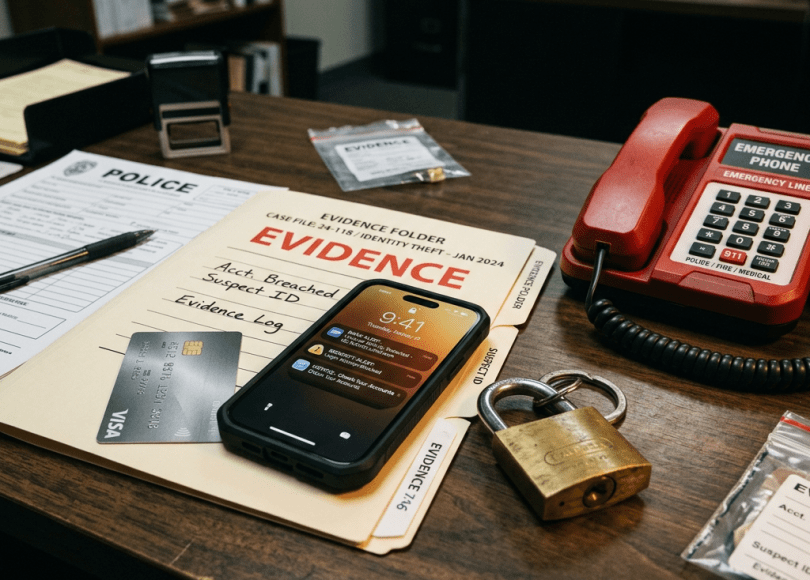
Create an evidence folder.
For example:
Cyber Fraud Evidence│├── Transaction SMS├── Bank Statement├── UPI Transaction├── Screenshots├── WhatsApp Chat├── Email├── Phone Numbers├── Call Logs├── Payment Receipts├── Website URLs├── APK File Information└── Cybercrime Complaint
Save the Transaction ID / UTR
This is one of the most important pieces of information.
Save:
- Transaction ID
- UTR
- RRN where applicable
- UPI transaction reference
- Date
- Time
- Amount
- Recipient information shown in the transaction
Don’t rely only on the SMS.
Take screenshots.
Download statements where possible.
Save Bank SMS Messages
Don’t delete:
₹50,000 debited from account…
Keep it.
Take a screenshot.
If your bank provides downloadable statements, preserve the relevant transaction.
Save UPI Screenshots
If the fraud involved UPI, save the transaction details.
Look for:
- UPI ID
- Amount
- Date
- Time
- Transaction/reference number
- Recipient information
- Status
Save WhatsApp Chats
If the scammer contacted you through WhatsApp:
Do not delete the chat.
Preserve:
- Entire conversation
- Phone number
- Profile name
- Profile photo
- Messages
- Documents
- APK files
- URLs
- Voice messages
Take screenshots as well.
If possible, preserve the original files rather than relying only on screenshots.
Save Emails
If the scam involved email, preserve:
- Sender address
- Subject
- Date/time
- Attachments
- Links
Don’t simply forward suspicious emails and then delete the original.
Keep the original evidence.
Save Phone Numbers
Write down every relevant number.
Including:
- Main scammer
- “Bank officer”
- “Police officer”
- “Customer support”
- Recovery scammer
- Other numbers used during the fraud
Don’t assume they’ll continue using the same number.
Save Call Logs
Your phone’s call history can establish:
- Which number called
- Date
- Time
- Duration
Take screenshots.
Save Payment Receipts
If you transferred money using:
- UPI
- IMPS
- NEFT
- RTGS
- Card
- Wallet
save the transaction receipt.
Save Website URLs
If you visited a fake website, save the exact URL.
Don’t just write:
“It was a bank website.”
Save:
https://example...
if it is still available.
The domain can become useful evidence.
The National Cyber Crime Reporting Portal also provides a facility for reporting suspicious identifiers such as websites, phone numbers, email IDs, WhatsApp numbers/Telegram handles and social-media URLs.
What If the Scammer Sent an APK?
This is extremely important.
One common fraud pattern involves sending an Android APK while pretending it is:
- KYC update software
- Bank application
- Electricity bill application
- Police notice
- Courier tracking app
- Job application
- Investment application
- Customer-support application
Do not install it.
If you already installed it:
Disconnect the device from the internet if you believe the app is actively compromising the device, and seek trusted technical assistance.
Then focus on securing your accounts from a clean device where possible.
Don’t casually open the APK again just to “see what it does.”
Preserve relevant evidence safely.
If You Installed a Suspicious APK
Treat the situation as potentially serious.
From a trusted device:
- Contact your bank.
- Report the financial fraud.
- Change important passwords.
- Review account sessions.
- Revoke suspicious access.
- Check UPI and banking activity.
- Consider resetting the compromised phone after preserving necessary evidence.
If the device contains important evidence for an investigation, consider getting guidance from the police/cybercrime unit before destroying or altering potentially relevant evidence.
What If You Gave the Scammer an OTP?
Tell the bank.
Immediately.
Also tell them exactly what information you disclosed.
Don’t hide it because you’re embarrassed.
The bank needs to understand what happened.
What If You Shared Your UPI PIN?
Treat it as urgent.
Contact your bank immediately and secure the affected payment account.
Remember:
Your UPI PIN is not a payment-receiving password.
You should never enter a UPI PIN merely to receive money.
What If You Scanned a QR Code?
A QR code isn’t inherently safe or dangerous.
The important question is:
What did the QR code cause you to do?
If you scanned a QR code and then entered your UPI PIN or approved a collect/payment request, money could be transferred.
If money has moved:
Call your bank + 1930 immediately.
Common Cyber Frauds in India
Scammers constantly change their stories.
But many scams use the same basic psychological tricks.
1. Fake KYC Scam
You receive:
“Your KYC has expired.”
“Your bank account will be blocked today.”
“Update KYC immediately.”
Then comes a link.
You click.
The fake page asks for:
- Account number
- Card number
- CVV
- OTP
- UPI information
The attacker gets what they need.
Red flags
- Urgent deadline
- Threat of account closure
- Unknown link
- Request for OTP
- Request to install an app
2. APK Scam
The scammer sends an Android application.
They say:
“Install this to complete KYC.”
“Install this to track your courier.”
“Install this to receive your refund.”
“Install this for your job interview.”
The application may request powerful permissions.
This can turn a phone into a serious security problem.
Never install banking APKs sent through random WhatsApp messages.
Get banking apps from official app stores or the bank’s official website.
3. Digital Arrest Scam
This scam is particularly psychologically aggressive.
The victim receives a call from someone claiming to be:
- Police
- CBI
- ED
- Customs
- RBI
- Telecom authority
- Supreme Court
- Other government agency
Then comes the threat:
“Your Aadhaar was used in a crime.”
“A parcel containing illegal items was found.”
“You are under investigation.”
Then:
“You are under digital arrest.”
They may keep the victim on a video call for hours.
They may demand money for:
- Verification
- Bail
- Security deposit
- Account verification
- Money laundering investigation
Remember:
A video call does not magically turn a scammer into a police officer.
A person showing a fake ID card on camera doesn’t establish their identity.
If someone threatens you into transferring money:
Stop. Disconnect. Verify independently.
4. Fake Police / Government Officer Scam
Scammers impersonate government officials and use:
- Fake ID cards
- Logos
- Uniforms
- Official-looking documents
- Video calls
- Fake case numbers
Their goal is fear.
The objective is to make you act before thinking.
5. Bank Customer-Care Scam
You search:
“Bank customer care number”
You click a suspicious result or social-media post.
A fake “customer-care executive” answers.
Then asks for:
- OTP
- CVV
- UPI PIN
- Screen sharing
- Remote-access app
The scammer may empty your account.
Always obtain contact information from the bank’s official website, app, card, or statement.
6. UPI Fraud
UPI has made payments incredibly convenient.
Scammers exploit that convenience.
Common tricks include:
- Fake payment requests
- Fake refunds
- Fake customer support
- QR-code scams
- “Receive money” scams
- Fake invoices
Remember:
Receiving money does not require entering your UPI PIN.
If you are being asked to enter your PIN to “receive” money, stop.
7. Investment Scam
It begins beautifully.
Someone shows you:
₹5,000 → ₹12,000
Then:
₹12,000 → ₹30,000
Your account appears to be growing.
You invest more.
Then suddenly:
“Pay ₹50,000 tax to withdraw.”
Then:
“Pay verification fee.”
Then:
“Pay GST.”
Then:
“Pay account activation.”
The numbers on the screen may be completely fake.
8. Job Scam
The victim receives:
“Work from home.”
“Earn ₹5,000 daily.”
Then comes:
“Pay ₹999 registration.”
Then:
“Deposit ₹5,000 to unlock tasks.”
Then:
“Complete one more level.”
The victim keeps paying because they’ve already invested money.
This is often a psychological trap.
9. Parcel / Courier Scam
A caller claims:
“A parcel in your name contains illegal items.”
Then asks for:
- Aadhaar
- OTP
- Money
- Video call
- Police verification
It’s another fear-based impersonation scam.
10. Electricity Bill Scam
“Your electricity will be disconnected tonight.”
A link follows.
The victim enters payment information.
Or installs an application.
Never let an unexpected deadline push you into entering financial credentials.
Verify through the electricity provider’s official channels.
11. Refund Scam
You receive:
“Your refund is pending.”
The scammer then asks you to:
- Install an app
- Share screen
- Enter card details
- Enter OTP
- Approve UPI payment
A refund should not require surrendering control of your banking account.
12. Loan Scam
A fake lender promises:
“Instant loan. No documents.”
Then demands:
- Processing fee
- Insurance
- GST
- Verification payment
The loan never arrives.
13. Matrimonial / Romance Scam
The scammer builds trust over weeks or months.
Then an emergency appears:
Medical emergency.
Customs problem.
Business crisis.
Travel problem.
Family emergency.
The victim sends money because they believe they’re helping someone they know.
14. Social Media Impersonation
Someone creates an account pretending to be:
- Friend
- Relative
- Celebrity
- Business
- Government official
Then asks for money.
Verify through another communication channel before transferring anything.
15. Fake Trading / Crypto Scam
You are shown an apparently successful trading account.
The balance increases.
Withdrawal fails.
Then another fee appears.
The displayed balance may be nothing more than numbers on a fraudulent platform.
16. “Part-Time Task” Scam
You are offered simple online work.
Like products.
Complete tasks.
Rate businesses.
Then you’re asked to deposit money to unlock higher-paying tasks.
The scammer may even return a small amount initially to build trust.
Then the required deposits increase.
17. SIM / Mobile Number Scam
A criminal may attempt to trick you into revealing:
- OTP
- Personal information
- SIM-related information
If your phone suddenly loses network service unexpectedly, especially around suspicious account activity, contact your telecom provider immediately.
18. Social Media Account Recovery Scam
Your account is compromised.
Then someone approaches you:
“I can recover your Instagram account.”
“I know someone at Meta.”
“Pay me and I’ll restore it.”
Another scam can begin immediately after the first.
Use the platform’s official recovery process.
The Psychology Behind These Scams
Why do intelligent people fall for them?
Because scammers don’t necessarily attack technology first.
They attack human psychology.
Fear
“Your account will be blocked.”
Authority
“I’m calling from the police.”
Urgency
“Do it in five minutes.”
Greed
“You’ve won ₹10 lakh.”
Trust
“I’m your bank manager.”
Curiosity
“See who searched for you.”
Romance
“I need your help.”
Shame
“Your name is connected to an illegal transaction.”
When your brain enters panic mode…
You stop evaluating the situation normally.
That’s exactly what the scammer wants.
The Most Dangerous Sentence in a Scam
“Don’t tell anyone.”
If someone says:
“Don’t call your bank.”
“Don’t speak to your family.”
“Don’t disconnect this call.”
“Don’t tell the police.”
That should be a massive warning sign.
Legitimate institutions do not need to isolate you from everyone who could help you verify a claim.
What NOT to Do After a Cyber Fraud
Don’t send more money.
Even if they promise to reverse the first transaction.
Don’t delete evidence.
Preserve it.
Don’t confront the scammer.
Let investigators handle it.
Don’t install another “recovery” application.
It could be another scam.
Don’t publish sensitive evidence publicly.
Don’t post your full account number, Aadhaar, card number, OTP, or other sensitive information on social media.
Don’t wait.
Every minute matters.
What If the Scammer Says Your Money Is Being Recovered?
Be careful.
After reporting a fraud, criminals may contact victims again.
They may say:
“We are from the recovery department.”
“Your money has been frozen.”
“Pay ₹20,000 to release it.”
That’s another scam.
Verify everything independently through official channels.
Should You Go to the Police?
Yes.
Especially for significant financial loss or serious cybercrime.
After making the immediate online/telephone reports, go to the appropriate cyber police station or police station and submit a written complaint.
Take copies of:
- Bank complaint
- 1930 complaint/reference
- NCRP acknowledgement
- Transaction details
- Screenshots
- Chats
- Emails
- Phone numbers
- Receipts
- Other evidence
Ask for an acknowledgement/receiving for your written complaint.
Keep it safely.
What If Your Local Police Station Says It’s an Online Matter?
Explain that you are a victim of financial cyber fraud and that you have already reported it through the national cybercrime system.
Keep your complaint/reference numbers.
If you need to escalate or follow up, the National Cyber Crime Reporting Portal provides State/UT nodal and grievance officer information, and the portal says complainants who used its Report & Track facility can contact the relevant officers if the response is not appropriate.
Create a Complete Timeline
This is one of the most useful things you can do.
Write:
10:03 AM — Received WhatsApp message.
10:05 AM — Clicked link.
10:07 AM — Installed APK.
10:11 AM — Received call.
10:15 AM — Entered information.
10:18 AM — ₹50,000 debited.
10:20 AM — Called bank.
10:23 AM — Called 1930.
10:31 AM — Filed NCRP complaint.
10:45 AM — Visited police station.
This timeline makes your complaint much easier to understand.
Don’t Modify Evidence Needlessly
If a suspicious APK or malicious application was involved, don’t keep interacting with it.
If possible, preserve:
- Original messages
- Original files
- URLs
- Screenshots
- Transaction records
If the device itself may contain important evidence, avoid unnecessarily wiping it before discussing the situation with investigators or a qualified forensic professional.
What Happens After You Report?
You may have several parallel processes:
Bank/payment provider
The bank investigates the transaction and takes steps according to its procedures.
1930 / I4C system
The financial-fraud reporting mechanism is intended to facilitate rapid coordination around fraudulent transactions.
Cybercrime portal
Your complaint is registered through the national reporting system.
Police
State/UT law-enforcement agencies handle cybercrime complaints and subsequent action under applicable law.
Investigation
Depending on the case, investigators may work with banks, payment intermediaries, telecom providers, platforms and other relevant entities.
How Long Does Money Recovery Take?
There is no universal timeline.
Some cases may be resolved quickly.
Others can take much longer.
And some money may never be recovered.
The sooner you report, the better the possibility that intervention can occur before funds move further.
But don’t believe anyone who promises:
“You’ll definitely get 100% of your money back.”
Nobody can guarantee that.
A Very Important RBI Point
For certain unauthorized electronic transactions, RBI’s framework provides customer-liability protections based on circumstances and how quickly the customer reports the transaction. For example, the RBI framework provides zero liability in specified situations when reported within three working days, with different treatment in other circumstances. Customer negligence—such as sharing payment credentials—can affect liability.
That means:
Report immediately.
Don’t assume you have to wait for a bank investigation before raising the issue.
And don’t assume that voluntarily sharing an OTP, PIN or credentials automatically produces the same outcome as an unauthorized transaction.
Your exact circumstances matter.
Your Emergency Cyber Fraud Checklist
If money has just been stolen:
- Stop communicating with the scammer.
- Call your bank through an official channel.
- Ask the bank to block/freeze affected accounts/payment channels.
- Block cards if card details may be compromised.
- Secure UPI/mobile/net-banking access as appropriate.
- Get the bank complaint/reference number.
- Call 1930 immediately.
- File the financial-fraud complaint at cybercrime.gov.in.
- Save the NCRP acknowledgement/reference number.
- Save transaction ID/UTR/RRN.
- Save bank SMS and statements.
- Save screenshots.
- Preserve WhatsApp chats/emails.
- Save scammer phone numbers and URLs.
- Write a timeline of events.
- Submit a written complaint to the police/cyber police.
- Take a receiving/acknowledgement.
- Change compromised passwords from a trusted device.
- Enable MFA/passkeys where available.
- Do not pay anyone promising guaranteed recovery.
Save These Numbers and Websites Now
National Cyber Crime Helpline
1930
The official portal identifies this as the immediate reporting helpline for financial cyber fraud and lists it as 24×7.
National Cyber Crime Reporting Portal
Use the official Government of India portal for reporting cybercrime and financial fraud.
Check / Report Suspect Identifiers
The NCRP also provides facilities for reporting suspicious identifiers such as phone numbers, WhatsApp/Telegram handles, email IDs, URLs and social-media URLs.
The Golden Rule of Cyber Fraud
If you remember only one thing from this article, remember this:
Don’t waste time being embarrassed.
You can feel angry later.
You can investigate later.
You can figure out exactly how the scam worked later.
Right now:
Bank.
1930.
Cybercrime portal.
Evidence.
Police complaint.
The scammer wants you to panic.
Then they want you to hesitate.
Then they want the money moved again.
Your job is to break that sequence as quickly as possible.
Final Thoughts
Cyber fraud can happen in seconds.
A single tap.
A single OTP.
A single UPI approval.
A single APK installation.
A single phone call.
And money you’ve spent years saving can begin moving away from you almost instantly.
But don’t assume the moment the money leaves your account, everything is over.
Act.
Call your bank.
Report the fraud to 1930.
File the complaint on cybercrime.gov.in.
Preserve every piece of evidence.
File a written police complaint.
Get your acknowledgements.
Secure your remaining accounts.
And keep following up.
There is never a guarantee that stolen money will be recovered.
But waiting gives you nothing.
The fastest possible report gives the relevant institutions and investigators the best opportunity to act while the transaction trail is still fresh.
So if you’re reading this because you have just been scammed:
Stop reading this article.
Pick up your phone.
Call your bank.
Call 1930.
Report it at cybercrime.gov.in.
Every minute you save can matter.
Discover more from Spyboy blog
Subscribe to get the latest posts sent to your email.
